Showing posts with label 2015 read. Show all posts

Tuesday, April 26, 2016

"The Cosmic Connection" By Carl Sagan

I found this book in a used book store and bought it simply because it was written by Carl Sagan.

Summary: This is a non-fiction book in which Sagan discusses projects and theories that he is familiar with regarding our place in the universe and the possibilities of contacting other intelligent life. Surprisingly for a book written in the 1970's, it is a nice introduction to all the major ideas on the topic. For example, he discusses Dyson spheres, which still comes up today as an exciting futuristic idea. Similarly, he spends time considering the SETI program, both in terms of finding evidence of other life and ways that others might find us.

One gem is his discussion of the plaque added to Pioneer 10 as a message for any extra terrestrials that might discover it in flight. Sagan was the person who made it happen on this mission and several following missions. His insight as to the intentions and the process of designing the plaque is something you likely wont find in any other book.

He shares his experiences studying dolphins, giving insight into the difficulties in communicating with a totally different but intelligent lifeform. The most persuasive point he makes in arguing that dolphins are in fact intelligent is that they have learned several words in English, but not a single human has learned any Dolphin. It is a fascinating idea to think that maybe dolphins are as smart as we are, and the thing that distinguishes us from them is our manual dexterity and ability to use tools.

I am also extremely fond of Chapter 37, where he begins his Starfolk narrative. Chapter 37 is subtitled A Fable and recounts the history of us, from the beginning to today. It places us right here and now, in context, cleanly and clearly, with the grandeur of myth, but without the falsehoods.


What I Liked: I love the feel of Sagan's writing. He is 100% that one professor you had that was able to pack profound knowledge into a casual conversation. His books feel like a transcript from a musing lecture with the rigor of a researched publication.

What I Didn't Like: I have no complaints about Sagan.

Rating: Recommended.

Also Read by this Author: Pale Blue Dot, The Demon-Haunted World.

Reviewed by: Nick


Tuesday, March 8, 2016

"The Road" By Cormac McCarthy

I first heard of this when the movie came out. As I like post-apocalyptic stories, it's been in the back of my mind for a while now and so I decided to finally read it. 

Summary: This story begins after an apocalyptic event. Based on the environmental effects and hints in the flashback scenes I believe the event was a nuclear war, followed by nuclear winter. Nowhere in the book is it explicitly stated, and this is likely because knowing the details of the event is not an immediate concern for the characters.

The protagonists are a father and a boy who are walking along a road, trying to get south where they believe the weather will be warmer. They are not the last two people in the world, but for much of the book it feels that way because the father does not trust anyone at all. His only goal is to protect his son and is unwilling to let anyone get in the way or complicate the situation.

As they walk the road, they are forced to make many choices as they encounter people and suspiciously wonderful places. The father is the constant voice of caution, while the son, who has known only the wasteland, is full of hope and wonder. He does not mourn the loss of the old world, and it frees him to dream up how good this new world could be.

What I Liked: I liked how it presented a believable environment. I have recently stumbled across a cold war documentary that took a scientific look at the effects of nuclear winter, and so when I read The Road I noticed the detailed resemblance. I also like of McCarthy shrugs off all the bits of a story that don't really matter in this tale. There's no need for names, or long prologues. There's the two guys and then there is the immediate world as they experience it. 

What I Didn't Like: I have an unsatisfied feeling after reading it, like it is the prologue to something more.

Rating: Recommended for anyone. Must read if you like the genre.

Also Read by this Author: None.

Reviewed by: Nick

Tuesday, March 1, 2016

"The Return of the King" by JRR Tolkien

In middle school I got half way through the Two Towers. I stopped because I found it depressing and the elven was unintelligible, but now that I am an adult nerd, I feel like I should have all four of them under my belt, and not just the movies. At the library I saw all four in audiobook format and decided I could finally finish the series. 

Summary: This story begins right where The Two Towers leaves off. Most of the original fellowship has set to work in defending the lands of Gondor while Frodo and Sam are on their own adventure. Minas Tirith is assaulted by a massive army of orcs from Mordor. The long battle is the balancing point to determine of the evil Saruon will be able to steamroll over Middle Earth or not. Every resource is thrown into the fight on both sides, with several close calls saved at the last minute.

While nearly the whole world is distracted by the battle, Frodo and Sam are able to work their way through many challenges in the lands of Mordor, with Gollum behind them all the while. The power of the ring to corrupt is a constant threat to the mission and to their own survival.

At the end of the book, the hobbits return home to find they don't recognize it anymore. It has been marked by the war and by a new evil leader who has only just taken power in the Shire. Our hobbits are now veterans of a great war, something rare among hobbits, and decide to take on this leader themselves.

What I Liked: I like that it concludes the story. I also really like the way the war is handled in the Shire and when the hobbits come home they get to be the main heroes with no tall folk stealing the spotlight.

What I Didn't Like: This book took me the longest to get through. The grand pronouncements of doom combined with the pining for a lost age makes for a really depressing read. I'm also somewhat sick the idea that heroes must let villains go free so that the heroes aren't turned into villains. There are some villains so dangerous that to let them free is a terrible, terrible idea and this book has a nice example of what happens when that dangerous villain is also a powerful wizard.

Rating: Read it as part of the series.

Also Read by this Author: The HobbitThe Fellowship of the Ring. The Two Towers.

Reviewed by: Nick

Tuesday, February 23, 2016

"The Maltese Falcon" by Dashiell Hammett

Several months ago I stumbled across a collection of old-time radio plays. Many of them were detective stories, and of those there was a large collection of Sam Spade capers. After listening to them, I became fascinated with Spade, learning that he was first made popular with the movie The Maltese Falcon, which was based on the book. After watching the movie, I found the book. 

Summary: Sam Spade is a detective who runs a small agency with his partner Archer. A woman hires them to follow a man so that they can find the client's sister who is with him. Archer offers to tail the man that night and before sunrise, he is dead off the side of the road. The prime suspect is killed later that same night and police suspect that Spade got revenge for the death of his partner.

The trouble with summarizing this story too much more is that it is full of twists and turns as new characters are brought in and new pieces of information are slowly uncovered. Spade is a very clever detective who takes big risks somehow knowing that they are going to payoff, when any other man would have made a safer choice only to be punished for it. He is also very efficient at putting the pieces together and keeping track of what is fact and what is only conjecture.

What I Liked: All of the characters in this story are enchanting. It is clear that they all are missing critical information of one kind or another, but they act boldly trusting that what they do know is enough to see them through. There are a lot of interesting ethical case studies in which people can argue what is the right thing to do in each situation, and there isn't necessarily one answer.

What I Didn't Like: Obviously, there is a cultural difference between 1930 and today. Many of the uncomfortable social relics of the past are preserved in this story.

Rating: Must Read.

Also Read by this Author: None.

Reviewed by: Nick

Tuesday, February 9, 2016

"The Strain" by Guillermo Del Toro & Chuck Hogan

I saw this audiobook on the shelf at the library and decided to give it a shot. Guillermo Del Toro has created some movies I really liked and I decided even though I didn't think of him as an author, I'd give it a shot. 

Summary: This story builds up in the manner of an X-Files episode. An airplane has landed at JFK without any hiccups, but once it was on the ground the pilots stopped responding on the radio. It quickly becomes clear that something horrible had happened and Eph Goodweather is responsible for figuring out what.

As the story develops we learn that a powerful vampire was on board and everyone he bit is coming back as ghouls. Eph is with the CDC and so his team and partners play a large role trying to determine the facts of the case. We also meet Vasiliy Fet, a strong-willed exterminator trying to explain the strange behavior of rats as he explores the tunnels. And Abraham Setrakian, an elderly pawnshop owner who knows more than he should.

What I Liked: I love investigation style stories, especially when they take a real-world career and pit it against a strange new enemy. This one unfolds nice and slowly to really bask in it. Eph is a great character that is very likable despite his flaws, perfect for the role of protagonist. Ron Pearlman was a perfect choice for the audiobook.

What I Didn't Like: Vampires are not my favorite monster. I prefer zombies and other pandemic style threats over specific individuals with superpowers, and so I was hoping that the strain in the title would play a larger role that would overshadow the vampire element.

Rating: Recommended.

Also Read by this Author: None.

Reviewed by: Nick

Tuesday, February 2, 2016

"A Court of Thorns and Roses" by Sarah Maas

Lately Instagram has been my go-to for finding new books to read.  The Young Adult #bookstagram movement is as strong as it is fabulous.

Summary:  Feyre lives in a small town with her depressed, emotionally dead father and two older, ungrateful and nasty sisters, in a shack that is all the family can afford since their fall from grace, money and power.  In order to survive, Feyre does what she can to put food on her family's table.  She hunts, she trades and she works twice as hard as she should to keep her family alive.  During a hard winter with death looming over her shoulder, Feyre takes to the woods to find meat - any meat - for her family.  She spies a deer in the forest and can't believe her luck...until she sees a larger-than-life wolf hunting the same prey.  On instinct, Feyre shoots the wolf, killing him almost instantly while the deer gets away.  Feyre soon learns that the wolf wasn't an ordinary wolf, that she in fact killed a member of the high Fey in disguise.

In order to keep peace between their two peoples, Feyre must trade her life for that of the Fey she murdered.  But there's a twist.  Instead of being put to death, Feyre must live in an enchanted castle at the Summer court of the Fey, surrounded by creatures she can't always see and magic she can feel but cannot touch.  What at first seems like a land of plenty and prosperity soon begins to wither, as Feyre learns that even the Fey are not all powerful.  An evil greater than she can understand threatens all she knows and all she's come to care for.

My Thoughts:  I loved this book.  The pacing was excellent, the story unique, characters vivid, and the plot as twisty and deep as an old river.  What starts out as a Beauty and The Beast retelling soon turns into its own saga, complete with magic, forbidden love and a battle to the (literal) death.

I mostly liked Feyre...as much as I can like any teenager.  Maas does a superb job capturing the iron will of someone who's had to grow up too soon and mixing it with the rash decisions and selfcentric world view of the young.  Feyre is both strong-willed yet scared, cunning yet naive, compelling yet shallow.  She is real in all her imperfections and I couldn't have asked for a better young adult heroine.  (Note:  I had no idea how to pronounce Feyre, so I called her Farrah the whole time.)

I also enjoyed the secondary characters.  Tamlin is fascinating in his strong yet silent way.  He suffers in a role he did not want yet works hard to succeed at anyway.  He loves, but must hide it.  And he comes off sexy in an alpha-male sort of way.  Rhysand is the classic bad boy/dark lover character.  He is both evil (like really evil) and alluring and I can't wait to see where book 2 takes his character.  (But please not a love triangle.  That is too expected and honestly, that would be disappointing.)

I did feel like the book was 100 pages too long.  Don't get me wrong, it was good, but good lord did it take forever to read.  If I was the editor, I would have cut the scene where Feyre goes home to her family.  I understand that her family finally comes to appreciate her, and that this is (hopefully) set up for the sequel, but it was slow going for me.  I also would have shortened the final challenge scenes, because this is where the book feels disjointed and rushed to me.  I understand that Feyre needs to kick ass and prove her worth, but in the end it felt like the entire sequence was set up for Rhys instead of closure for Tamlin.

Rating:  I'll read it again.  Check it out if you like Young Adult or Fantasy.

Also Read By:  N/A

Reviewed By:  Tami

Tuesday, January 12, 2016

"The Two Towers" By JRR Tolkien

I read this book in middle school, and got half way through the Two Towers. I stopped because I found it depressing and the elven was unintelligible, but now that I am an adult nerd, I feel like I should have all four of them under my belt, and not just the movies. At the library I saw all four in audiobook format and decided I could finally finish the series. 

Summary: This story begins right where The Fellowship of the Ring leaves off. At this point in the story, the fellowship is broken. Frodo and Sam go off one way, Merry and Pippin are kidnapped by the enemy and the the rest of the party ends up plotting a rescue. Merry and Pippin get free and hide in the forest, only to discover it is the home of the Ents, treelike beings that care for the woods. The Ents are not fond of hurrying and take their time in all things, but the growning danger from Saruman is enough to mobilize them under the leadership of Treebeard. They go to Isengard assault the walls.

Aragorn and company meanwhile search for the two hobbits and eventually find Gandalf, which they had thought dead. Together they go to the king of Rohan and argue with him, trying to make him see the looming dangers.

The other two hobbits, Frodo and Sam, are now alone as they march toward Mordor. They are intensely aware that no one is going to help them through the hardest part of their journey, but they are able to manipulate Gollum into working for them at times, as Gollum respects the Ring and fears what might happen to it if he does not cooperate.

What I Liked: I like that it continues the story and gives more depth to the world of Tolkien. There is a feel of greatness in the comings and goings of Frodo, Aragorn, Gandalf and the others. 

What I Didn't Like: When I was in middle school I read this book halfway. It just became too hard to get excited about it, the whole story felt bogged down. Listening to it as an audiobook is the only way I got through. It's hard to pinpoint exactly what stopped me, but there is a certain sort of depression that feels overly reaching when it is proclaimed by kings and wizards mourning the passing of an age. It feels a little forced.

Rating: Read it as part of the series.

Also Read by this Author: The Hobbit. The Fellowship of the Ring

Reviewed by: Nick

Tuesday, December 29, 2015

"Game of Thrones" by George RR Martin

I was introduced to this story through the television show and was looking for a way to try my library's ebook checkout system. I saw this title right away and knew it would be a good read. I downloaded it and read it like an ordinary ebook, but the special library app made sure I "returned" it at the end of the allotted time. 

Summary: In the land of Westeros there are seven kingdoms united together under one king. Each region is ruled by a powerful family and is divided again among lesser lords. What makes this story exciting is that political power ebbs and flows from lord to lord depending on hundreds of decisions, strategies and plots.

This book spends most of it's time centered around Ned Stark and his family. He is the Lord of Winterfell and was critical in helping the king gain the throne from the Mad King who was so horrible that one of his own guards finally killed him. After some key battles were won, King Robert was crowned. And now the king's highest adviser is dead, so Ned has been asked to replace him. As Ned learns more and more about what is happening in the capital, it looks worse and worse.

Every piece is moving in this chess game and there is no way to anticipate how it will all play out. Those of you who have seen the show, it is basically the same story as season one. The big difference with the book is that you get to spend a lot of time inside the head of each character, watching them analyze their situations and weigh the pros and cons of action. In the show you see what they do, but in the book you read why they do it.

What I Liked: I loved the show, and I am glad that the book has the same feel without making me feel like I have to say one is better than the other. Both are amazing.

What I Didn't Like: I'm not sold on the library ebook system. I still can't get over the idea that my software is due back so that someone else can read it.

Rating: Must Read.

Also Read by this Author: None.

Reviewed by: Nick

Tuesday, December 22, 2015

"The Fellowship of the Ring" by JRR Tolkien

I read this book in middle school, and got half way through the Lord of the Rings trilogy. I stopped because I found it depressing and the elven was unintelligible, but now that I am an adult nerd, I feel like I should have all four of them under my belt, and not just the movies. At the library I saw all four in audiobook format and decided I could finally finish the series. 

Summary: This story takes place several decades after The Hobbit in which Bilbo goes on an adventure and happens to find a very useful ring. It is The Ring. Centuries ago, Sauron gave out rings of power to various factions hoping to win their trust and loyalty. And he had a special secret because he made one more ring that was designed to control the others. Sauron lost the ring in battle and it changed many hands until finally reaching Bilbo, a small hobbit in the Shire. Young Frodo inherited the ring when Biblo decided to leave the Shire right around the time Gandalf began to understand the true power of the thing.

As Sauron grows in power and threatens the lives of every race, Gandalf the Grey thought on the fate of the ring for some time, finally deciding that any plan which did not include destroying was too dangerous. Unfortunately, the only way the ring could be destroyed was to drop it in the pits of Mordor where it was forged. The rest of the book is assembling a team to bring the ring to Mordor and destroy it before the wraiths of Sauron can seize it.

What I Liked: Since I liked The Hobbit I appreciate any book in the same universe. Also, this is quintessential fantasy with elves, dwarves, wizards and brave knights. This first book in the trilogy is very hopeful and eager. The characters are worried, but motivated to complete their mission. 

What I Didn't Like: Some of the decisions made by the wise folk are a bit confounding. One option they have is to send the ring to the opposite side of the world, and they figure that Sauron will catch up with it some day, so that's not good enough. It seems to me, that if it delays the problem several generations, its still a win, whereas bringing the ring straight into Sauron's fortress hoping to destroy it seems more dangerous. Also, while I am complaining, Tom Bombadil is older than the world, and bends the world to his will, yet he can't be bothered to help destroy the ring. I mean, he could have totally saved the day without breaking a sweat!

Rating: Recommended.

Also Read by this Author: The Hobbit.

Reviewed by: Nick

Tuesday, December 15, 2015

"The Hobbit" By JRR Tolkien

I read this book in middle school, and got half way through the Lord of the Rings trilogy. I stopped because I found it depressing and the elven was unintelligible, but now that I am an adult nerd, I feel like I should have all four of them under my belt, and not just the movies. At the library I saw all four in audiobook format and decided I could finally finish the series. 

Summary: This book takes place several decades before the Lord of the Rings series and is not technically part of the series, though it does introduce a few characters and provides a context for the trilogy that comes later.

In this book, Bilbo Baggins is a hobbit living by himself in a nice hole safely placed in the Shire. He is tricked by Gandalf, a mysterious old man known for his amazing fireworks and said to be a wizard, who invites a thirteen dwarves to his hobbit hole. Eventually, Bilbo figures out that he is hosting the planning meeting for an expedition to the Lonely Mountain so that it might be reclaimed for the dwarves.

Bilbo joins Thorin Oakenshield and his dwarves on a dangerous adventure eastward. They meet elves, trolls, goblins and eagles as they navigate through the Mirkwood. At one critical juncture, Biblo finds the Ring which eventually sparks the events in the trilogy.

What I Liked: I am a gamer, mostly Dungeons and Dragons style games. When you are playing D&D there is a certain sort of banter where players egg each other on and make all sorts of comments that make fun or make light of the situation no matter how seriously it is supposed to be. I found it very comforting that the characters in The Hobbit sound like D&D gamers! They stumble around the puzzle built for them by Tolkien, then say and act in ways that are a combination of stupid and wise. It's clear Tolkien was having fun with the story.

What I Didn't Like: Frankly, of the four books, this is my favorite one. The ending is a bit weird, since the hero sort of pops in at the last moment, but whatever. I must say one thing, though. Gandalf is not particularly awesome in this book. He can make fireworks and smoke rings, and shows up then disappears at random times, but there isn't much wizardry yet.

Rating: Must Read.

Also Read by this Author: To come later, since I am rereading them.

Reviewed by: Nick

Tuesday, December 8, 2015

"World War Moo" by Michael Logan

I found this book at an independent bookstore called Uncle Hugo's and knew that I just had to read it. I did not see the first book, though, so I picked it up at the library and read that first.

Summary: The biological weapon accidentally released from the government facility has infected nearly every mammal living in Britain. Luckily, the ocean and the Channel have provided a barrier to prevent the spread so far, providing that the blockade does not fail. The virus makes the infected seek out and violently attack the uninfected, but as there no longer are any uninfected available, the is dormant. The infected humans have stopped rioting and destroying, and have begun to rebuild.

China, the United States and Russia control the main military response to the outbreak and are eager to nip it in the bud before it crosses the water, while Brits for the Rights of the InfecTed (BRIT) is scrambling for a way to prevent an attack.

While the international tensions are building, Geldof, our young hero from Apocalypse Cow, is living with his wealthy grandfather when they learn his mother is still alive in Britain, and uninfected. A rescue attempt is organized while Lesley the reporter finds herself in trouble after asking too many questions.

What I Liked: This book has the same style of humor I loved from the first book and provides more insight into the characters I loved. I also really love the interesting scenario that BRIT finds itself in, struggling to make peace with an enemy that they view as prey.

What I Didn't Like: One of the reasons I love apocalypse stories is because they often take a regular guy at the grocery store and suddenly, he has to create a plan to survive the zombie wars. This book doesn't have that feel, as that all happened in book one. Since this is the sequel, the pace is a little different, with some tension from high stakes global politics and some from people taking on dangerous missions.

Rating: Recommended.

Also Read by this Author: Apocalypse Cow.

Reviewed by: Nick

Tuesday, December 1, 2015

"Risky Game" by Tracy Solheim

I saw a highly rated review of this book on and thought I'd pick it up from the library.  I felt a little guilty, like I was cheating on Miz Roberts, but I figure its OK to take a little break as I wait for the next trilogy to come out.
Image via Goodreads


Summary:  Professional football tight end (see what she did there) Brody Janik is an all-star on and off the field.  Incredibly handsome and a natural athlete, Janik lives a charmed life...until he is diagnosed with high blood sugar.  Afraid his medical condition will hinder his contact renewal, Janik decides to hide his secret from the team.  Except team intern and PhD candidate Shay Everett overhears Janik's secret while spying on the team to gather information to sell to a gossip blogger.

Although Shay works hard---three jobs hard---to support herself through grad school, Shay can't stomach the thought of selling out someone else for some easy cash.  But although Shay decides to keep Janik's secret to herself, Janik soon learns that Shay is in the know, and decides to keep his friends close and his enemies closer via blackmail.

What starts out as a working relationship of convenience soon blossoms into something more as Janik learns to appreciate a woman that challenges him and Shay learns how to rely on someone other than herself.

My Thoughts:  I've never read a sports romance before; in fact I wasn't even aware they existed.  Let me tell you...I've been missing out!  This book was everything I look for in a romance:  witty dialogue, interesting characters, a look into the lives of people with jobs I know nothing about, a sexy romance with believable emotion, funny supporting characters and a happy ending.

Janik and Shay had a snarky, interesting dynamic that made the couple's ascent into love believable.  Janik and Shay didn't fall into love, or even like, right away.  Both characters had to grow throughout the story in order to fall for each other.

Brody Janik is a proverbial golden boy - rich, talented and handsome, but he's also self aware in a way that I found refreshing in a romantic hero.  Janik recognizes that his life is charmed right now, but is afraid of what will happen after football.  This fear keeps his eyes on the prize - renewing his contract - even when he knows he needs more to be satisfied in life

Shay is tough and intelligent and her traits help her keep her eye on her prize - her PhD and and lined up job that will help her save her mom's business.  Emotionally abused by her overbearing Meemaw (side note...ick) Shay's biggest challenge is loving herself enough to let herself be loved.

As Janik and Shay interact, their personalities grow in such a way that their instant sexual attraction turns into real believable romantic chemistry.  And I ate it up like a carton of Ben & Jerry's on a Thursday night.

Rating:  I'll read this again, and I've already requested the rest of the series from the library.

Also Read By Author:  Nada, but I'm going to check out all her stuff.

Reviewed By:  Tami

Tuesday, November 24, 2015

"Gulliver's Travels" By Jonathan Swift

I picked up this audiobook as it is a classic and I never read it.

Summary: Gulliver is a man who spends much of his life at sea, as a surgeon, captain and ship owner. On four separate trips he ridiculously lost and finds himself in a land well beyond anything charted on any map. This premise is a bit absurd, but ultimately, it is an excuse to place Gulliver in societies that look nothing like the British lands he grew up in.

The first land he finds is filled with people incredibly smaller than him. He is enslaved by them and spends much of the time trying to convince them that he is not going to destroy them. The second place is filled with people much bigger than him and he is paraded around like a fancy pet in a special box. The third place is a floating city that rests on powerful magnets that repel the earth. These are scientist/philosophers with their time dedicated to pondering. The forth place, my favorite, is the land of the horse people. Here the horses are intelligent and the humans are of animal minds. These ignorant humans are called Houyhnhnms and Swift goes out of his way to use it as an insult against British elites, over and over.

In each place Gulliver takes careful note of every similarity and difference between the strangers and his own homeland. Much of the book is a critique of 18th century Britain by demonstrating how much better these strangers appear to be. And when similarities are highlighted, they are often so that Swift can use the fictional characters to illustrate the flaws he sees in British society. These observations are delivered as devoid of emotion as possible to give them a feeling of simple scientific truth, which makes the jokes that much funnier.

What I Liked: Swift takes full advantage of the story to comment on the lives of his fellow citizens. He does not

What I Didn't Like: It sounds stupid, but I have difficulty with classics partly because of the language barrier, we'll call it. These days, no one talks like Swift, and it means I have to spend extra effort to figure out what some of the sentences mean. It's not his fault, but it still detracts from the experience.

Rating: Recommended.

Also Read by this Author: None.

Reviewed by: Nick

Tuesday, November 17, 2015

"When Books Went to War" By Molly Guptill Manning

I heard an interview with the author on the radio and a few months later saw the audiobook at the library. 

Summary: As the Nazis gained power they campaigned against certain books, hosting book burnings and eventually banned books outright. As the allies challenged the axis on the battlefield, there was a parallel conflict building up. In America librarians and others united to fight the fascists in the war of ideas. As the Nazis burned them, the Americans distributed them.

In the beginning there were civilan book drives with drop offs all across the nation. They accepted all books and worked to get them into army training camps and deployment centers so that soldiers could select a title and read at their leisure. The idea was to show that America supported freedom of the press and to remind soldiers what they were fighting for.

The book drives proved inadequate because people dropped off books that were unwanted and impractical, especially the large hardcover editions that could not be carried by a soldier in the field. The government then organized a program to publish special Armed Services Editions of various titles selected by a council. The books were custom designed to fit in a soldier's pocket and stay with him until he was done reading it. Many consider the program to be reason millions of people became lifelong readers after the war.

What I Liked: The importance of books in World War II is great. I love the idea of a council whose only job is to get as many books into soldier's hands as a way to fight the enemy.

What I Didn't Like: This book has no story arc or protagonist. There is no compelling build up to keep you reading. If this wasn't an audiobook I am not sure I would have finished.

Rating: If you have an interest in WWII or book history, you might like it, otherwise, probably not.

Also Read by this Author: None.

Reviewed by: Nick

Tuesday, November 10, 2015

"The Bourbon Kings" by J.R. Ward

I'm a big fan of J.R. Ward's Black Dagger Brotherhood series.  I enjoy her over the top characters and her heavy hand with rap references gives me shivers of pure glee.  "The Bourbon Kings" is the first book in a new, non-supernatural series.

Summary:  The Bradford Family is Southern Royalty.  Extremely wealthy and even more entitled, the newest generation of Bradfords play hard and spend harder, without really caring where it comes from or how its made.

Tulane "Lane" Bradford is the youngest son of the family.  Devastatingly handsome and very charming, he lives in New York to escape an unhappy (understatement) marriage, a domineering father, absent mother, messed up siblings and the love of his life, who's heart her broke when he married someone else.

Lane gets a phone call that brings him home to the family's estate, Easterly, where the glamour and privilege enjoyed by the Bradfords starts to crumble.  As Lane realizes he needs to man up, his romance with Lizzie rekindles as his family falls apart.

My Thoughts: I'm still torn about "The Bourbon Kings" and its been a few weeks since I've read it. Part of me enjoyed the story in a rubbernecking, guilty pleasure sort of way.  I am endlessly fascinated by the train wreck lives of the idle rich.  Add in dark family secrets, a little bit of intrigue and a quickie in the million dollar wine cellar and I'll be turning the pages faster than a Kardashain can take a selfie.

"The Bourbon Kings" had all of that, but...the characters also left me so cold that I couldn't find it in my bookwormy heart to sympathize with them when the choices they made brought them to the lowest of lows.  These characters aren't just the idle rich, they are entitled to the point of ridiculousness.  They don't own their mistakes unless forced to, don't work for anything they're given, and really have almost no redeeming qualities.

Lane thinks he impregnates a college fling and marries her, despite being in love with someone else.  Then, instead of facing the fact that he made a mistake he runs off to a life of alcoholism and gambling.  Even after he learns that his gold-digging wife aborted their baby.  Although Lane is the male lead of the romance in "The Bourbon Kings", I didn't find him worthy of the leading lady.

Lizzie King, the leading lady of the book, is an an independent, strong willed woman.  She's the head gardener at Easterly, works hard and knows her worth.  Except amid the chaos of the Bradford family, she ends up feeling like a supporting cast member.  I was far more interested in the messed up Bradfords than the romance between Lane and Lizzie.  Plus, I wanted Lizzie to see that she could do better than Lane and run away as far as she could.  A hot body and a Porsche aren't worth it.

My gut reaction to the miserable characters and their glamorous lives is that Ward is bringing each member of the Bradford family to their low point before raising them up.  Towards the end of the story Lane filed for divorce and even took a minor interest in unraveling the mess of the family business.

Point of interest, I still can't wrap my mind around the only lady Bradford.  Ginny, the only daughter of the family, is filled with so much self loathing and fear that she agrees to marry her rapist instead of get a job.  SAY WHAT?  Add in the fact that she doesn't interact with her teenage daughter and can't be bothered to pick up her own clothes, I found absolutely nothing likeable about her except for her taste in accessories.

Rating:  I found the romance lack luster but the family drama titillating.  I'm glad I read it, moreso that I got it from the library.

Also Read by This Author:  All of the Black Dagger Brotherhood series, most of the Fallen Angels series.

Reviewed By:  Tami

Tuesday, November 3, 2015

"Apocalypse Cow" by Michael Logan

I found the sequel to this book at an independent bookstore called Uncle Hugo's and knew that I just had to read it. I read them in order, though.

Summary: The British government created a secret weapons program designed to destroy the food supply of potential enemy nations. The weapon of choice was a virus custom built to infect cows and similar food animals. Unfortunately, the virus got out and infected a slaughterhouse.

This story follows a group of people including a lousy journalist who gets the biggest break in history, a nerdy teenage boy who has the most ridiculous parents and the sole surviving slaughterhouse worker who is kidnapped by the government. They all start out in different places but find themselves thrown together in a world filled with murderous cows.

In the beginning, no one knows how bad it is, and so they try to go about normal life. As the epidemic gets worse, people begin to panic and the government initiates their response plans. The virus spreads to more and more animals until the group finally decide to escape the UK.

Special note, this book won the Terry Pratchett Prize in 2011, with Pratchett writing a forward.

What I Liked: The humor in this book is amazing. There are lots of great puns, hilariously awkward scenes and killer cows. In general, I like post apocalyptic stories, and Logan fully takes advantage of the serious genre all the while making interesting characters and compelling plot. Take out the cows and this is still great writing, but the cows make it that much better.

What I Didn't Like: ......

Rating: Must read.

Also Read by this Author: None.

Reviewed by: Nick

Tuesday, October 27, 2015

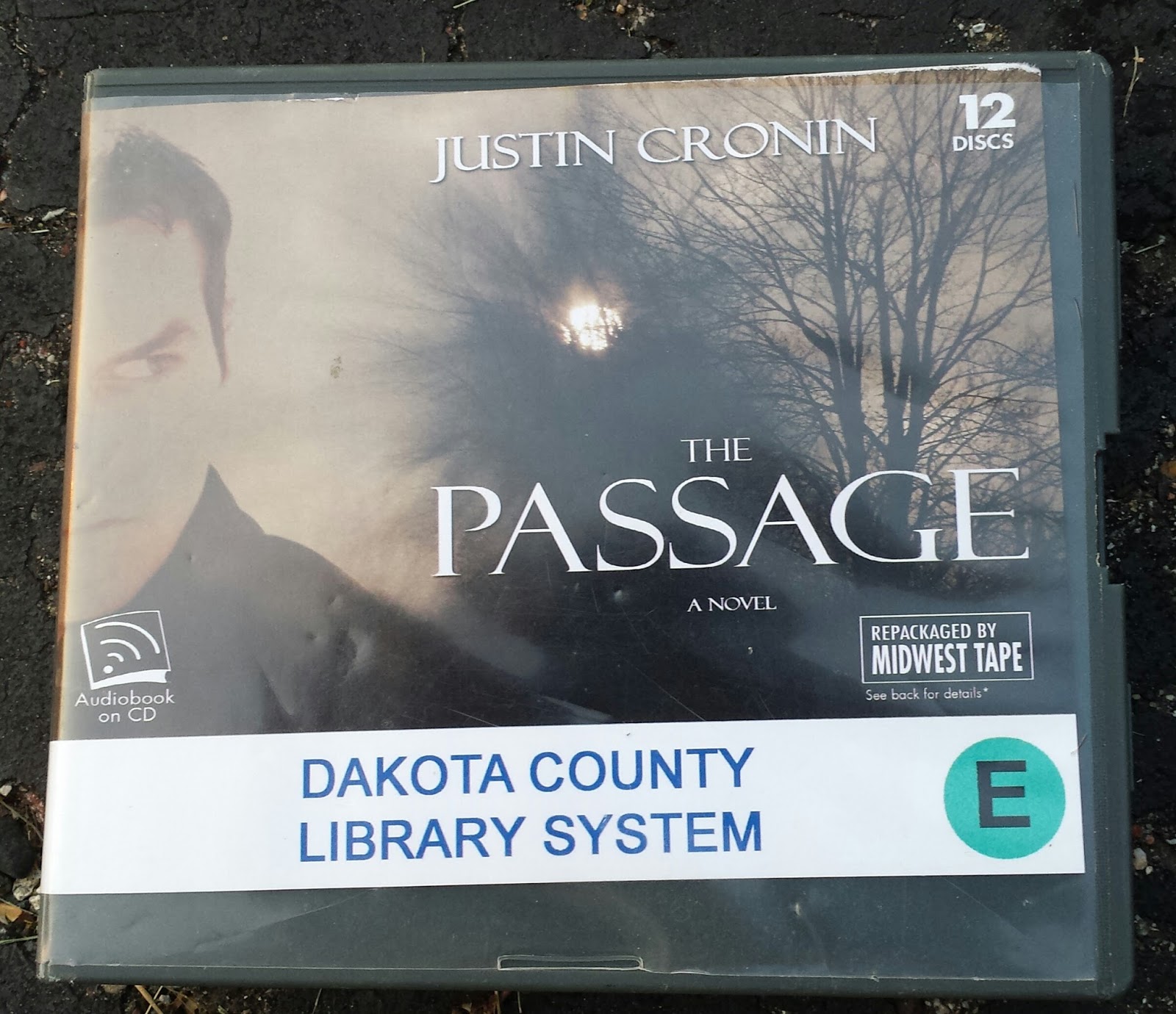
"The Passage" by Justin Cronin

Tami read this book a while back and had planned to read the sequel. We picked up this audio book to refresh her memory and get me up to speed.

Summary: In the jungles of South America, a strange virus infects an academic team. The U.S. military quickly establishes a program to research the virus and weaponize it. The virus brings on a dramatic transformation in the victim that turns them into fast, nocturnal blood-suckers. Twelve death-row inmates were the first guinea pigs and did not show the desired effects. One more subject was given the virus, but before the results could be analyzed, the facility fell and the subjects escaped. Quickly the whole continent was infected and the life as we know it is gone.

Years later the survivors struggle to make a living in a world filled with the infected creatures, called virals. Bright lights protect the isolated colony of survivors, and everyone has a job to do. But there are signs that the colony cannot last. Slowly, a plan comes together and an adventure begins.

What I Liked: There's a lot to think about in this book. The virals are fascinating, the characters are well rounded and the plot is compelling.

Tami enjoyed the layout of the plot.  The first half of the book is back-story to the action that takes place 100 years in the future.  The back-story written in such a compelling manner that it might just be my favorite part.  There is something morbidly fascinating about watching society as its known fall.

What I Didn't Like: I realized too late that this is the abridged version. I then wondered what scenes I missed. Also, my favorite character died really early.

Tami thought it was scary, and there were parts that turned my stomach.  But each bit of the plot was necessary to advance the story, so I suffered through it.

Rating: This has all the right elements of a post apocalyptic story. I recommend it.

Also Read by this Author: None.

Reviewed by: Nick (with Tami chiming in)

Tuesday, October 20, 2015

"Going Clear" by Lawrence Wright

I heard about this book when it was being made into a movie. Then I saw it on it the shelf at the library and picked it up.

Summary: This reads like an in depth expose on the church. The book explores the biography of Hubbard and the history of the church from its founding. It starts with a look at Hubbard's life as a science fiction writer and naval officer. It reviews deception in his service record and his injuries. It then goes into the creation of dianetics which evolved into the modern church. There was a significant period where the church was mainly sea-going and struggled with prohibitions in several countries. They endured a long legal battle with the IRS and governments in Europe.

Eventually, the church is accepted as a legitimate religious organization and grows. Much of their energy is spent on recruiting and maintaining celebrity members including a strong presence in Hollywood offering classes and workshops for movie stars. This book takes a close look at how the church treated Tom Cruise and John Travolta. It also has a lot to say about Paul Haggis, a famous screenwriter, producer and director. It examines claims of physical and psychological abuse in the Sea Org (the clergy) and the many practices of the church that have given it the terrifying reputation it has today.

What I Liked: Before this book I did not know much about Scientology beyond the rumors I heard from atheists and critics of the church. After this book I have a better grasp of what the church is like on the inside and what were major events in its timeline.

What I Didn't Like: This book was exactly what I hoped it would be. The only downside to an audiobook is that I don't have the same ease regarding citations.

Rating: Very informative. I recommend it for anyone who wants to know more about Scientology.

Also Read by this Author: None.

Reviewed by: Nick

Tuesday, October 13, 2015

"Fangirl" by Rainbow Rowell

I saw mini reviews of "Fangirl" posted around Instagram I liked the cover, and people seemed to really appreciate the story, so I picked it up from my local library!
Image via Goodreads

Summary:  Cath is your average 18 year old on the cusp of college...well, average if you're afraid of change, confused by normal social interactions and obsessed with a boy wizard.  (So in my experience, average.)

"Fangirl" is about a girl who goes to college for the first time and finds herself totally out of her element.  Cath starts off alone, intimidated by her new life and a little scared to take the next step into adulthood.  She'd be just fine back at home, sharing her bedroom and her love of Simon Snow fanfiction with her twin sister, keeping track of her depressed dad, and eating from every taco truck in sight.

But college forces everyone to grow up, whether they're ready or not.

Cath soon finds herself making friends with her kinda-scary roommate, co-writing a story with a kinda-cute guy from her creative writing class, and learning about herself outside of her role as twin sister, daughter, and superstar fanfic writer.  Oh, and she meets a man.

My Thoughts:  Good books take the reader through a range of emotions as the story progresses.  "Fangirl" was no different.

I started out uncomfortable, possibly because Cath hits a little too close to home.  She's so anxious about starting college that she spends all her time in class or hiding out in her room.  Going to the cafeteria in her dorm or talking to her roommate are too much for her.  I can relate to this, as my own freshman (and sophomore....and junior) years were quite similar.  Because of my personal experience, and because I know what it's like on the other side, I was uncomfortable and at times disappointed in Cath for letting her anxiety keep her from meeting people and experiencing new things.

As Cath branches out beyond her dorm room, I got more comfortable with the story and started to revel in Cath's quirkyness.  Cath is unashamed of her obsession with the wildly popular Simon Snow series.  She revels in total lack of desire to party with her sister.  And she loves a good hipster sweater.  While Cath has a penchant for crying that occasionally made me want to punch her in the face, her quick comebacks and good heart kept me cheering her on.

Then there is sadness.  So much sadness.

And then there is the ending.  But you'll have to read the book to find out if it's happy or not.

Rating:  I recommend it, and I'll read it again.

Also Read By:  None, but I'll check out more by Rainbow Rowell

Reviewed By:  Tami

Tuesday, October 6, 2015

"Doomed" By Chuck Palahniuk

This is the sequel to Damned which I enjoyed. I listened to it as an audiobook.

Summary: Madison Spencer is a ghost. She spent time in Hell, and on Halloween she returned to the land of the living. If a ghost leaves Hell on Halloween, they must return by midnight, or be stuck in the mortal realm until the next Halloween. Madison missed midnight and began to settle in for the year. Like the previous book, this one has two intermingled stories. The story is presented as a series of blog posts, often referencing other users' comments and questions.

The first is a flashback to when Madison was a child, focusing on a long stay with her grandparents in upstate New York. She becomes interested in Darwin and goes on a Naturalist adventure. She then finds herself in a terrifying situation and recounts the death of her grandparents. Throughout these retellings we see the clues to a larger conspiracy to shape Madison's fate.

The other story follows Madison as a ghost while she stalks her parents. They hire a paranormal investigator to locate her. The investigator operates by overdosing on drugs and having near-death experiences where he then talks with ghosts. He finds Madison and escorts her to her parents who have built up a cult. In the previous book, Madison had instructed her parents to do a list of bad deeds in order to guarantee their family would be reunited in Hell. Madison told them she was in Heaven, and as they are world famous celebrities they shared the instructions with their followers. The cult of Boarism developed in which everyone is offensive, but no one takes offense. This new religion then takes an apocalyptic turn that has Madison worried.

What I Liked: This book builds off the first and answers many questions. It also develops the plot, bringing it to a new level. I love the little details Palahniuk includes, making the world feel immediate and real.

What I Didn't Like: This book has the single most disturbing death scene I have ever read or watched. It is described in careful detail and involves some very disgusting elements. It might haunt me forever.

Rating: I enjoyed this as a sequel as it fills out a lot of the story and builds on it, but it was not as compelling as the first book.

Also Read by this Author: Fight Club, Damned.

Reviewed by: Nick