Showing posts with label audiobook. Show all posts

Tuesday, March 1, 2016

"The Return of the King" by JRR Tolkien

In middle school I got half way through the Two Towers. I stopped because I found it depressing and the elven was unintelligible, but now that I am an adult nerd, I feel like I should have all four of them under my belt, and not just the movies. At the library I saw all four in audiobook format and decided I could finally finish the series. 

Summary: This story begins right where The Two Towers leaves off. Most of the original fellowship has set to work in defending the lands of Gondor while Frodo and Sam are on their own adventure. Minas Tirith is assaulted by a massive army of orcs from Mordor. The long battle is the balancing point to determine of the evil Saruon will be able to steamroll over Middle Earth or not. Every resource is thrown into the fight on both sides, with several close calls saved at the last minute.

While nearly the whole world is distracted by the battle, Frodo and Sam are able to work their way through many challenges in the lands of Mordor, with Gollum behind them all the while. The power of the ring to corrupt is a constant threat to the mission and to their own survival.

At the end of the book, the hobbits return home to find they don't recognize it anymore. It has been marked by the war and by a new evil leader who has only just taken power in the Shire. Our hobbits are now veterans of a great war, something rare among hobbits, and decide to take on this leader themselves.

What I Liked: I like that it concludes the story. I also really like the way the war is handled in the Shire and when the hobbits come home they get to be the main heroes with no tall folk stealing the spotlight.

What I Didn't Like: This book took me the longest to get through. The grand pronouncements of doom combined with the pining for a lost age makes for a really depressing read. I'm also somewhat sick the idea that heroes must let villains go free so that the heroes aren't turned into villains. There are some villains so dangerous that to let them free is a terrible, terrible idea and this book has a nice example of what happens when that dangerous villain is also a powerful wizard.

Rating: Read it as part of the series.

Also Read by this Author: The HobbitThe Fellowship of the Ring. The Two Towers.

Reviewed by: Nick

Tuesday, February 23, 2016

"The Maltese Falcon" by Dashiell Hammett

Several months ago I stumbled across a collection of old-time radio plays. Many of them were detective stories, and of those there was a large collection of Sam Spade capers. After listening to them, I became fascinated with Spade, learning that he was first made popular with the movie The Maltese Falcon, which was based on the book. After watching the movie, I found the book. 

Summary: Sam Spade is a detective who runs a small agency with his partner Archer. A woman hires them to follow a man so that they can find the client's sister who is with him. Archer offers to tail the man that night and before sunrise, he is dead off the side of the road. The prime suspect is killed later that same night and police suspect that Spade got revenge for the death of his partner.

The trouble with summarizing this story too much more is that it is full of twists and turns as new characters are brought in and new pieces of information are slowly uncovered. Spade is a very clever detective who takes big risks somehow knowing that they are going to payoff, when any other man would have made a safer choice only to be punished for it. He is also very efficient at putting the pieces together and keeping track of what is fact and what is only conjecture.

What I Liked: All of the characters in this story are enchanting. It is clear that they all are missing critical information of one kind or another, but they act boldly trusting that what they do know is enough to see them through. There are a lot of interesting ethical case studies in which people can argue what is the right thing to do in each situation, and there isn't necessarily one answer.

What I Didn't Like: Obviously, there is a cultural difference between 1930 and today. Many of the uncomfortable social relics of the past are preserved in this story.

Rating: Must Read.

Also Read by this Author: None.

Reviewed by: Nick

Tuesday, January 12, 2016

"The Two Towers" By JRR Tolkien

I read this book in middle school, and got half way through the Two Towers. I stopped because I found it depressing and the elven was unintelligible, but now that I am an adult nerd, I feel like I should have all four of them under my belt, and not just the movies. At the library I saw all four in audiobook format and decided I could finally finish the series. 

Summary: This story begins right where The Fellowship of the Ring leaves off. At this point in the story, the fellowship is broken. Frodo and Sam go off one way, Merry and Pippin are kidnapped by the enemy and the the rest of the party ends up plotting a rescue. Merry and Pippin get free and hide in the forest, only to discover it is the home of the Ents, treelike beings that care for the woods. The Ents are not fond of hurrying and take their time in all things, but the growning danger from Saruman is enough to mobilize them under the leadership of Treebeard. They go to Isengard assault the walls.

Aragorn and company meanwhile search for the two hobbits and eventually find Gandalf, which they had thought dead. Together they go to the king of Rohan and argue with him, trying to make him see the looming dangers.

The other two hobbits, Frodo and Sam, are now alone as they march toward Mordor. They are intensely aware that no one is going to help them through the hardest part of their journey, but they are able to manipulate Gollum into working for them at times, as Gollum respects the Ring and fears what might happen to it if he does not cooperate.

What I Liked: I like that it continues the story and gives more depth to the world of Tolkien. There is a feel of greatness in the comings and goings of Frodo, Aragorn, Gandalf and the others. 

What I Didn't Like: When I was in middle school I read this book halfway. It just became too hard to get excited about it, the whole story felt bogged down. Listening to it as an audiobook is the only way I got through. It's hard to pinpoint exactly what stopped me, but there is a certain sort of depression that feels overly reaching when it is proclaimed by kings and wizards mourning the passing of an age. It feels a little forced.

Rating: Read it as part of the series.

Also Read by this Author: The Hobbit. The Fellowship of the Ring

Reviewed by: Nick

Tuesday, December 22, 2015

"The Fellowship of the Ring" by JRR Tolkien

I read this book in middle school, and got half way through the Lord of the Rings trilogy. I stopped because I found it depressing and the elven was unintelligible, but now that I am an adult nerd, I feel like I should have all four of them under my belt, and not just the movies. At the library I saw all four in audiobook format and decided I could finally finish the series. 

Summary: This story takes place several decades after The Hobbit in which Bilbo goes on an adventure and happens to find a very useful ring. It is The Ring. Centuries ago, Sauron gave out rings of power to various factions hoping to win their trust and loyalty. And he had a special secret because he made one more ring that was designed to control the others. Sauron lost the ring in battle and it changed many hands until finally reaching Bilbo, a small hobbit in the Shire. Young Frodo inherited the ring when Biblo decided to leave the Shire right around the time Gandalf began to understand the true power of the thing.

As Sauron grows in power and threatens the lives of every race, Gandalf the Grey thought on the fate of the ring for some time, finally deciding that any plan which did not include destroying was too dangerous. Unfortunately, the only way the ring could be destroyed was to drop it in the pits of Mordor where it was forged. The rest of the book is assembling a team to bring the ring to Mordor and destroy it before the wraiths of Sauron can seize it.

What I Liked: Since I liked The Hobbit I appreciate any book in the same universe. Also, this is quintessential fantasy with elves, dwarves, wizards and brave knights. This first book in the trilogy is very hopeful and eager. The characters are worried, but motivated to complete their mission. 

What I Didn't Like: Some of the decisions made by the wise folk are a bit confounding. One option they have is to send the ring to the opposite side of the world, and they figure that Sauron will catch up with it some day, so that's not good enough. It seems to me, that if it delays the problem several generations, its still a win, whereas bringing the ring straight into Sauron's fortress hoping to destroy it seems more dangerous. Also, while I am complaining, Tom Bombadil is older than the world, and bends the world to his will, yet he can't be bothered to help destroy the ring. I mean, he could have totally saved the day without breaking a sweat!

Rating: Recommended.

Also Read by this Author: The Hobbit.

Reviewed by: Nick

Tuesday, October 27, 2015

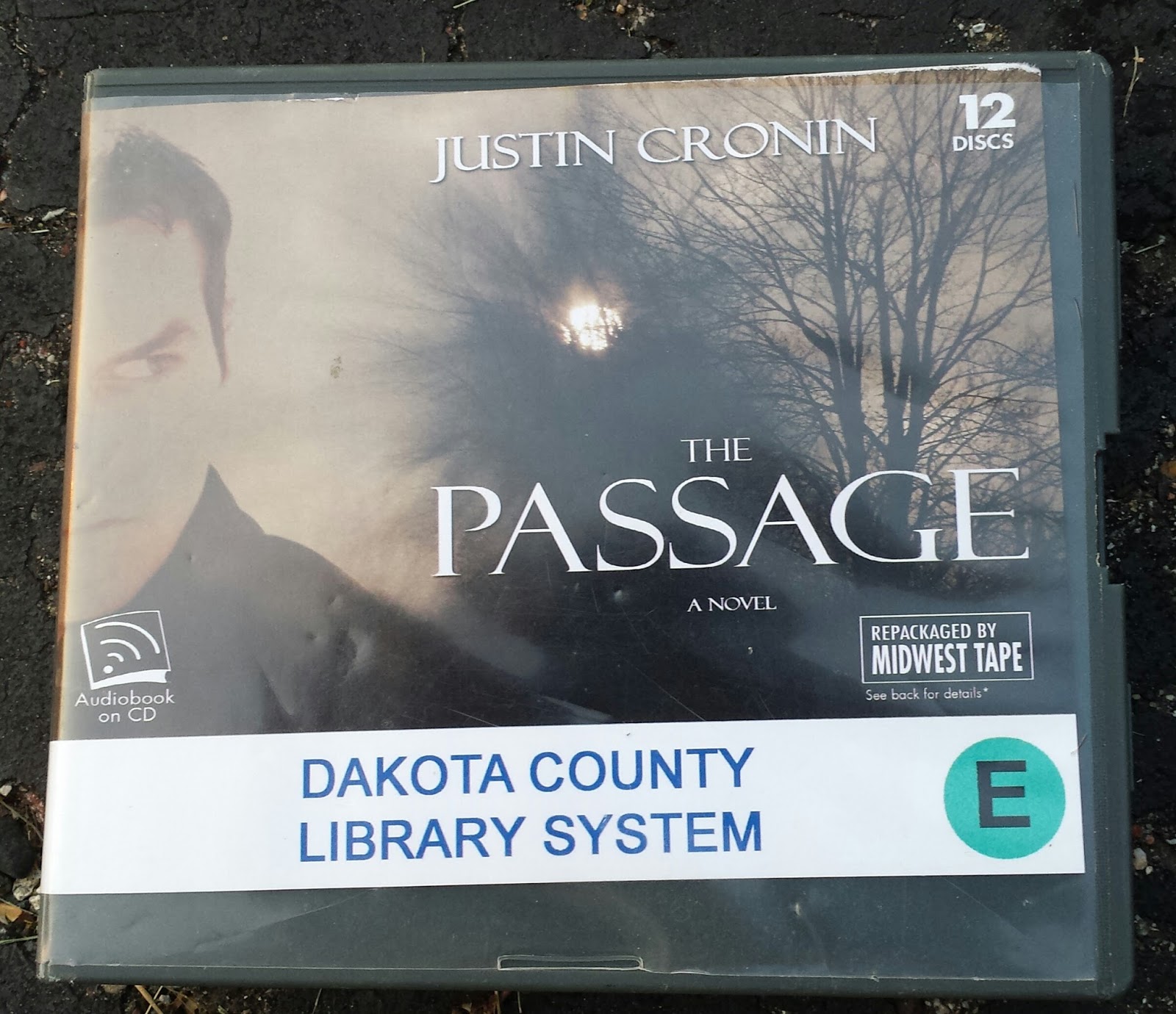
"The Passage" by Justin Cronin

Tami read this book a while back and had planned to read the sequel. We picked up this audio book to refresh her memory and get me up to speed.

Summary: In the jungles of South America, a strange virus infects an academic team. The U.S. military quickly establishes a program to research the virus and weaponize it. The virus brings on a dramatic transformation in the victim that turns them into fast, nocturnal blood-suckers. Twelve death-row inmates were the first guinea pigs and did not show the desired effects. One more subject was given the virus, but before the results could be analyzed, the facility fell and the subjects escaped. Quickly the whole continent was infected and the life as we know it is gone.

Years later the survivors struggle to make a living in a world filled with the infected creatures, called virals. Bright lights protect the isolated colony of survivors, and everyone has a job to do. But there are signs that the colony cannot last. Slowly, a plan comes together and an adventure begins.

What I Liked: There's a lot to think about in this book. The virals are fascinating, the characters are well rounded and the plot is compelling.

Tami enjoyed the layout of the plot.  The first half of the book is back-story to the action that takes place 100 years in the future.  The back-story written in such a compelling manner that it might just be my favorite part.  There is something morbidly fascinating about watching society as its known fall.

What I Didn't Like: I realized too late that this is the abridged version. I then wondered what scenes I missed. Also, my favorite character died really early.

Tami thought it was scary, and there were parts that turned my stomach.  But each bit of the plot was necessary to advance the story, so I suffered through it.

Rating: This has all the right elements of a post apocalyptic story. I recommend it.

Also Read by this Author: None.

Reviewed by: Nick (with Tami chiming in)

Tuesday, October 20, 2015

"Going Clear" by Lawrence Wright

I heard about this book when it was being made into a movie. Then I saw it on it the shelf at the library and picked it up.

Summary: This reads like an in depth expose on the church. The book explores the biography of Hubbard and the history of the church from its founding. It starts with a look at Hubbard's life as a science fiction writer and naval officer. It reviews deception in his service record and his injuries. It then goes into the creation of dianetics which evolved into the modern church. There was a significant period where the church was mainly sea-going and struggled with prohibitions in several countries. They endured a long legal battle with the IRS and governments in Europe.

Eventually, the church is accepted as a legitimate religious organization and grows. Much of their energy is spent on recruiting and maintaining celebrity members including a strong presence in Hollywood offering classes and workshops for movie stars. This book takes a close look at how the church treated Tom Cruise and John Travolta. It also has a lot to say about Paul Haggis, a famous screenwriter, producer and director. It examines claims of physical and psychological abuse in the Sea Org (the clergy) and the many practices of the church that have given it the terrifying reputation it has today.

What I Liked: Before this book I did not know much about Scientology beyond the rumors I heard from atheists and critics of the church. After this book I have a better grasp of what the church is like on the inside and what were major events in its timeline.

What I Didn't Like: This book was exactly what I hoped it would be. The only downside to an audiobook is that I don't have the same ease regarding citations.

Rating: Very informative. I recommend it for anyone who wants to know more about Scientology.

Also Read by this Author: None.

Reviewed by: Nick

Tuesday, October 6, 2015

"Doomed" By Chuck Palahniuk

This is the sequel to Damned which I enjoyed. I listened to it as an audiobook.

Summary: Madison Spencer is a ghost. She spent time in Hell, and on Halloween she returned to the land of the living. If a ghost leaves Hell on Halloween, they must return by midnight, or be stuck in the mortal realm until the next Halloween. Madison missed midnight and began to settle in for the year. Like the previous book, this one has two intermingled stories. The story is presented as a series of blog posts, often referencing other users' comments and questions.

The first is a flashback to when Madison was a child, focusing on a long stay with her grandparents in upstate New York. She becomes interested in Darwin and goes on a Naturalist adventure. She then finds herself in a terrifying situation and recounts the death of her grandparents. Throughout these retellings we see the clues to a larger conspiracy to shape Madison's fate.

The other story follows Madison as a ghost while she stalks her parents. They hire a paranormal investigator to locate her. The investigator operates by overdosing on drugs and having near-death experiences where he then talks with ghosts. He finds Madison and escorts her to her parents who have built up a cult. In the previous book, Madison had instructed her parents to do a list of bad deeds in order to guarantee their family would be reunited in Hell. Madison told them she was in Heaven, and as they are world famous celebrities they shared the instructions with their followers. The cult of Boarism developed in which everyone is offensive, but no one takes offense. This new religion then takes an apocalyptic turn that has Madison worried.

What I Liked: This book builds off the first and answers many questions. It also develops the plot, bringing it to a new level. I love the little details Palahniuk includes, making the world feel immediate and real.

What I Didn't Like: This book has the single most disturbing death scene I have ever read or watched. It is described in careful detail and involves some very disgusting elements. It might haunt me forever.

Rating: I enjoyed this as a sequel as it fills out a lot of the story and builds on it, but it was not as compelling as the first book.

Also Read by this Author: Fight Club, Damned.

Reviewed by: Nick

Tuesday, September 15, 2015

"Damned" by Chuck Palahniuk

I liked Fight Club enough that when I saw more books by Palahniuk I picked them up. This one is the first in a series. 

Summary: Madison Spencer is dead. At the age of 13 she got high, blacked out and woke up in a Hell surrounded by other damned souls. The form of the book is a series of letters that begin with "Are you there Satan? It's me Madison". She narrates two distinct stories that unfold side by side throughout the book.

The primary story follows her experiences in Hell in which she meets other kids and tries to figure out how things are organized in the afterlife. Demons roam the land slaughtering poor humans, whose bodies are reformed after every death to be eaten, dismembered, stabbed or squished over and over for all eternity. There is also a formal bureaucracy which manages incoming souls, career assignments and appeals. Madison's friends show her the ropes, including how to use the currency and how to make the system work for her. She finds a job as a telemarketer and acts on some bold initiatives.

The second story is made up of Madison's memories from her pre-dead existence. She was the daughter of a famous movie star and a powerful business executive, spending much of her life flying from home to home all over the globe. Her childhood is a mixture of normal growing up and totally bizarre events that might only happen to someone so wealthy as her. Palahniuk uses this as an opportunity to highlight some absurdities in our culture, especially criticizing rich liberal Hollywood elite. Madison recounts events that ultimately lead up to her death and discovers what was originally hidden from her.

What I Liked: This book is written in a compelling style, where Madison tells compact, but satisfying tales about herself, all of which build up to create a coherent narrative with a proper plot. It builds in such a way you have no idea what to expect until it happens, at which point the story only becomes more interesting.

What I Didn't Like: When I read it, I did not know it was first in a series, and so I thought the conclusion would be more complete. Instead, this ends on a bit of a cliffhanger, which leads into the second book.

Rating: I am realizing that Palahniuk must only write disturbing books. I am somewhat embarrassed by the idea someone else might read this book and wonder if I am a psycho for liking it. So it's hard for me to say this is a Must Read knowing that basically everyone will find something highly offensive or overly gross to continue reading it, but I recommend it despite that.

Also Read by this Author: Fight Club

Reviewed by: Nick

Tuesday, August 11, 2015

"Ender in Exile" by Orson Scott Card

This book is part of the Ender's Game series and as I have read the first five books plus the parallel Ender's Shadow series, I figured it would be worth my time. I listened to this as an audiobook on my phone.

Summary: At the end of Ender's Game we get something of a denouement in which humans colonize the old bugger worlds and a few satisfying details wrap up the story. In this new volume, the last couple chapters of Ender's Game are expanded greatly. We get to see Ender dealing with his new status as the most honored and most feared human in existence, loved and spurned by the masses. We get to see what life is like on the second wave of colony ships as they rush to their new homes and trail blaze a new political path as people begin to live light years away from each other. This is the first time civilians have had to deal with the realities of relativistic speeds compounded with the technology of cryogenic freezing makes for some interesting problems with ages and seniority.

We also get a glimpse into the world of Peter and Bean who are the stars of Ender's Shadow. If you loved that parallel series, there is some material in this book you might be interested in.

What I Liked: Ender gains some insights as to how he really won the war against the buggers and does a lot of reflection. This book is the denouement readers needed after the intensity of the first book.

What I Didn't Like: Honestly, this book was boring. I listened to it as an audiobook which means I did not have to do anything to keep up a good pace. There is very little action, even non-violent action. What builds the tension is finding out what doesn't happen.

Rating: Not the best of the series, but if you have already read most of them, it answers a lot of questions.

Also Read by this Author: Ender's Game, Speaker For the Dead, Xenocide, Children of the Mind, Ender's Shadow, Shadow of the Hegemon, Shadow Puppets, Shadow of the Giant, Shadow's in Flight, The Memory of Earth, The Call of Earth, The Ships of Earth, Earthfall.

Reviewed by: Nick

Tuesday, June 16, 2015

"The Ocean at the End of the Lane" by Neil Gaiman

Well, when I saw this audio book at the library I had forgotten that Tami had already written a review, but this book is new to me, and so I wanted to write my own review.  Ah, well. Neil Gaiman has a very good reputation among certain reading circles that I know. He is guaranteed to provide quality writing and creative storytelling. 

Summary: This book is presented as a man trying to recount his childhood on a rural road with some interesting neighbors, the Hempstocks. The tale starts with the family renting out a room and one of the tenants dying. This leads to a series of supernatural events that involve a spirit that goes around giving people what they want with disastrous results.

Much of the story has the next tenant, Ursula Munkton, as something of a villain. She seduces the boy's father and controls their lives. Much of the boy's problems come directly from Ursula.

Lettie Hempstock is a young girl living with her mother and grandmother. The three of them know more about the universe than they let on, with only hints sprinkled about the story. Lettie helps the boy with his problems and that forms the bulk of the book.  

What I Liked: This story is written almost in the style of magical realism where the world is presented as normal, but normal has a broader definition in the book than for we in the real world. This is partly because the main character is a child who is still getting oriented in the universe and asks questions more out of curiosity than disbelief.

What I Didn't Like: This is a forgettable story, for the most part. I couldn't write this review without reading a synopsis first, which I find surprising.

Rating: Entertaining.

Also Read by this Author: The Graveyard Book.

Reviewed by: Nick

Tuesday, June 9, 2015

"Factory Girls" by Leslie Chang

I heard this book mentioned in a discussion about the modern economy and then saw it on the library shelves.

Summary: Leslie Chang is an American journalist who spent several years conducting interviews in China. The main focus of this book is on the rise of factories and the migrant workers who fill them. She interviews several workers and a few of them maintain contact over the years even as they change cities and industries. Chang goes into detail regarding their working conditions and their social lives. She tours the various places of their lives, including taking a trip back to the farm from which one of the migrants was born. She highlights the ups and downs, including how most migrants seem to see factory work as an opportunity to rise economically. They are constantly improving skills and jumping from job to job, hoping to make it big. Chang also talks about the control that the factories have over workers, including deciding where they sleep, how many hours they work and even if they are allowed to collect their last paycheck.

Chang also takes the time to explore her own past and contrast it with the workers. Chang's great-grandfather was regionally powerful before the communist revolution. He was a government official and lived in a large compound, and controlling a large amount of land. Her grandfather was an important mining engineer during the Japanese invasion and eventually assassinated during the cultural revolution. Her family moved to the United States and Chang sees similarities in her personal migrant story and the girls who work the factories.


What I Liked: This is a good long perspective on the changes in China without feeling like a defense of any particular argument. She reports what she finds and lets the reader draw their own conclusions. This is the most comprehensive book I have read on China and I found it enlightening.

What I Didn't Like: Even though she compares the two themes of the factories and her family, it still felt like maybe they should have been two different books.

Rating: Recommended.

Also Read by this Author: None.

Reviewed by: Nick

Tuesday, April 7, 2015

"World War Z" by Max Brooks

I read World War Z when it first came out, then I went and saw the movie when it came out. Then I saw the audiobook at the library and listened to it at work with headphones on.

Summary: This book takes place about a decade after the zombie war has ended and humanity is rebuilding. Max Brooks decides to tour the globe and interview dozens of people to hear their personal stories from the war. He interviews scientists, soldiers, refugees, profiteers, war criminals and people who don't fit into a category, but were just trying to get through it all. Each person tells their story as they remember it happening and Max Brooks asks questions to try and flesh out the context or to pin down the truth. Certain historical events are assumed to have happened between right now and the first battle of the zombie war, which are hinted at throughout the book.

The interviews are organized into several sections based on the timeline of the war and context of the intended audience (which is American). There is a story for everything, as the incredibly complex unfolding of the war is revealed in small doses. By the end, it all hangs together as a clean whole.

As this is the audiobook, I must point out a few things. First, there are three editions, the abridged edition which came first, the Lost Files which was sold as a supplement to the abridged and a complete edition which has both. Second, this is not your traditional audiobook. This is closer to a radio play where Max Brooks plays the Interviewer and dozens of different actors play the variety of interviewees. Some highlights for the geek in me were Alan Alda, Mark Hamill, Nathan Fillion & Simon Pegg. All the readers did a fantastic job.

Also, I feel a certain obligation to say something about the movie World War Z. The movie is fun, I own it and I've watched it a few times. Definitely see it. But the movie has nothing to do with the book. There is no overlap beyond the fact that both stories deal with a global zombie infestation. As far as I can tell, no characters from the book are in the film, nor any unique story elements. Basically, Hollywood had a cool zombie movie and bought the rights to the name World War Z. Still, good movie.

What I Liked: I love how the story is presented, through interviews. Each person has a chance to recollect the events and string them together into a meaningful narrative, without having to make it fit into the bigger picture. And yet, they do all fit together quite well. Also, the grand story is a perfect balance of realistic despair, as humanity suffers massive losses to infection, and genuine triumph as humanity regains its footing to push back against the horde. It is both a story of failure and redemption on a global scale. 

What I Didn't Like: Obviously, I wish there were more interviews.

Rating: Must Read.

Also Read by this Author: Zombie Survival Guide

Reviewed by: Nick

Tuesday, March 10, 2015

"Mortality" by Christopher Hitchens

I was picking up books at the library for Tami and noticed this sitting in the audiobook section. As I am generally a fan of Hitchens I decided to check it out.

Summary: This is Hitchens' last book before his death. In truth, it is not even a full book as it explains that Hitchens believed he had more time to write more content and polish it before publishing. His sudden death means there are fragments left unedited, still in their first draft.

Much of the book originally appeared in articles he wrote while in treatment. It starts with Hitchens waking up very sick and unsure what was wrong. The doctor suspected cancer, but any conclusive test was still in the future. Hitchens writes candidly about his struggle to live a normal life, unwilling to fail his friends and fans. He also reflects on the nature of his treatment, the effects of chemotherapy and what it's like to show up at the clinic. As he died of throat cancer, he also writes about his loss of speech, something that his especially hard on a man who loved talking. This book also includes a forward and an afterward in which two people close to him talk about his last days.

What I Liked: This is Hitchens making the best of a bad situation. He retained his ability to write fiercely and strategically right up to the end. 

What I Didn't Like: Obviously, these are the dying words of a man I respected. I would rather they weren't his last.

Rating: Worth reading, but left with a guilty feeling.

Also Read by this Author: Hitch-22.

Reviewed by: Nick

Tuesday, February 3, 2015

"Agatha H and the Airship City" by Phil & Kaja Foglio

I was first introduced to these characters through the award-winning Girl Genius online comic. When I saw their book for the first time, I needed to read it. 

Summary: This book follows the first part of the online comic, in which Agatha begins as an ordinary lab assistant at the university of Professor Beetle. The professor is a Spark, a title which denotes individuals who have an especially sharp minds. Sparks can take a pile of discarded parts and build a fully functional vehicle in a day, they can rewire the brains of animals to give them human intelligence, and they can do it in a steampunk universe where computers and circuits have never been invented. Most sparks are very dangerous and mentally unstable. They bring terror and ruin to the people of Europe with their armies of combat squids and war klanks constantly fighting. Professor Beetle is peaceful by comparison and has found himself working for Baron Wulfenbach, the most powerful spark who presides over the continent with a fleet of airships.

In this book Agatha's life is totally turned upside-down and she meets a cast of characters pulled from across the continent and across species. She can no longer stay in the home she has always known, and must make do with strangers in the airship city of Castle Wulfenbach, where she finds herself again as a lab assistant. But this time things have gotten a lot more complicated. After reading the comics, this book feels like it is entirely exposition for the adventures that follow, but it is compelling in its own right.

What I Liked: As the comic updates three pages a week, it can be slow going to follow along. It was a fun look-back to recall how the stories began. The Foglio's inject everything with a joke, keeping the story light-hearted even when it's serious. Also, the steampunk theme is exciting and interesting, with monsters, talking animals, robots and zepplins!

What I Didn't Like: I am biased to like this book, not sure what to put here.

Rating: Must read.

Also Read by this Author: Girl Genius online comic.

Reviewed by: Nick

Tuesday, November 25, 2014

"Packing for Mars" by Mary Roach

I selected this book as it looked like an interesting book on space travel and the possibility of sending humans to Mars.

Summary:  This book is an exploration of all the questions you wanted to ask regarding space travel, but couldn't seem to find a NASA article on the subject. Mary interviews several people connected to the Japanese, American and Russian space programs in order to learn more about the effects of zero gravity, astronaut selection and the engineering of spaceships. Most of the book is historical, in that it uses information from the Gemini, Apollo missions and related research from that time period. 

Roach covers a variety of topics including space food, space toilets, space sex, space clothes, space bathing and much more. She also explores rumors of space scandals that NASA has tried to downplay. This is a book written by someone genuinely excited about space travel, but bored with the press releases and official statements. Roach wants to know all the dirty details about life in a spacecraft and shares her findings in this book.


What I Liked: This book is full of side comments in the footnotes. Roach can't help but add little tidbits here and there, like this excerpt from a discussion on drinking while in a spacesuit: "Consumed intravenously, Tang causes joint pain and jaundice, though fewer cavities."

What I Didn't Like: This book did not really look at the possibility of going to Mars. It should have been titled "Packing for the Moon (or ISS)". I had thought it would look into the science of a Mars colony.

Rating: Highly recommended, but for mature readers only as it includes topics that are generally considered inappropriate for children.

Also Read by this Author: None.

Reviewed by: Nick

Tuesday, November 11, 2014

"Endurance: Shakleton's Incredible Voyage" by Alfred Lansing

I selected this audiobook because I was not familiar with the details of Shackleton's expedition. I knew he was an antarctic explorer of some kind, but that was all.


Summary: This is the story of the Imperial Trans-Antarctic Expedition headed by Sir Ernest Shackleton. Lansing has interviewed crew members and read their diaries to piece together the story from start to finish. The story is told in dramatic fashion to match the drama of the journey. It is as though at every turn nature is trying to wipe these 28 men off the bottom of the map and it is only by hard work and a dribble of luck that they make it back to civilization.

As the story is now 100 years old, I can't be accused of spoiling it, so here's the basic plot. Shackleton is looking to be one of the great First's on the icy continent. Someone was already the first to reach the pole, and so he is planning to be the first to trek across the whole landmass. They are to go to the pole and then leave the continent on the other side. A separate expedition is organized to stash supplies on their exit route from the pole so that they need only bring half the gear with them. They take the ship the Endurance into the antarctic ocean and are trapped in ice. They eventually abandon ship and make camp. Shackleton and a small team then takes a lifeboat back across the ocean in search of help. This book follows the hardships and accomplishments of the men who stayed behind and the men who risked everything to save them.

What I Liked: This story has all the terror and excitement found in a sci-fi or fantasy book, and with the added bonus of being true! It is told in a very clear and direct manner so that you feel like the adventure is unfolding before you. Each chapter I was imagining myself alongside the men and wondering what I would do in their shoes. I got excited when they had good luck and became worried when things grew worse. Lansing is great at making the scene real.

What I Didn't Like: N/A.

Rating: Must Read.

Also Read by this Author: None.

Reviewed by: Nick

Tuesday, October 28, 2014

"Hitch-22" By Christopher Hitchens

I selected this audiobook because I have watched Christopher Hitchens debate many people on television and youtube, but had not read any of his books. 

Summary: This is a memoir in which Hitchens reflects on all the stages of his life and the people and places that played a major role. Interestingly, this is mainly focused on his professional and political life, avoiding much of the personal. He describes his relation with his parents, who he oddly refers to as Commander Hitchens and Yvonne. He talks about growing up as a student at a British boarding school and becoming politically awakened. As a young adult he quickly becomes very active in the worldwide socialist movement and visits many countries as part of solidarity actions, including working on a farm in Cuba. He also got an early start at his lifelong profession of writing. Hitchens wrote articles for his entire adult life and was able to participate in the grand discussions that surround major political events and catastrophes. He argued strongly with people on the right and on the left, trying to push forward his own idealist views of a better world.

He was uniquely positioned as an established liberal who supported the war in Iraq. He made several trips to the country and was convinced that Saddam Hussein had to be taken down, which put him at odds with the anti-war movement that surrounded him. He also became famous as one of the Four Horsemen of the Non-Apocalypse for speaking strongly against religion. He was active in many causes throughout his life and he discusses them with a precision that convinces me he kept a detailed diary.

What I Liked: I learned a lot about Hitchens' life before youtube and how he established himself in the political and journalistic spheres as someone worth listening to. It gives me a lot of context in understanding his positions in various debates and made me think about my own positions.

What I Didn't Like: Hitchens was married at least once, and had at least one kid, but beyond that I know almost nothing about his personal life after reading this book. It makes him feel incomplete.

Rating: Not for the average reader. Great for political science majors or fans of Hitchens.

Also Read by this Author: None.

Reviewed by: Nick

Tuesday, October 7, 2014

"Shadows in Flight" By Orson Scott Card

I selected this audiobook because I have already read eight books in this universe and really love the main character, Bean. 

Summary: This is this fifth book in the Ender's Shadow series and takes place about 400 years after the events in the first four books. Bean is flying through space with three of his children at near light speed, so that they will age slower than their friends and relatives back on Earth. Without this intervention, they would surely die in their twenties as everyone else grew old. They spend much of their energy researching their peculiar and rare genetic disease which makes their minds and bodies grow at the a constant pace. Their brains are perpetually learning like an infant, becoming geniuses at toddler age, but the constant growth means they will not stop in adulthood. Bean, in his twenties, is at the edge of death as his heart struggles to supply blood to is enormous body, even at 1/10th Earth's gravity. These four adventurers discover an ancient Formic ship and explore it to learn all kinds of new things about their one-time enemy. This story spends a lot of time exploring the inner thoughts and vocal debates between the four travelers.

What I Liked: This book takes the time to answer some of the lingering questions from the other eight books and develops more background on the Formics. Card really did make an interesting and exciting world which is a treat to read about.

What I Didn't Like: This is a low tension book, compared to the earlier Ender's Shadow series, and it felt shorter (and apparently is shorter). On a different note, I should say that Orson Scott Card has expressed many political views that I personally find distasteful and disrespectful, and makes me hesitant to give him money.

Rating: I recommend the whole series from Ender's Game to this book, though this is not the most exciting of the series.

Also Read by this Author: Ender's Game, Speaker for the Dead, Xenocide, Children of the Mind, Ender's Shadow, Shadow of the Hegemon, Shadow Puppets, Shadow of the Giant, The Memory of Earth, The Call of Earth, The Ships of Earth, Earthfall.

Reviewed by: Nick

Tuesday, September 23, 2014

"American Chronicles World War I" by National Public Radio

I selected this audiobook because I am a regular listener of NPR and generally curious about World War I (partly because of watching Downton Abbey and partly because of an amazing history teacher in high school who made the class play a complicated homemade game which demonstrated quite effectively how the Great War began. 

Summary: This is an audio collection put together by the NPR staff. As far as I can tell, this is only available as an audiobook, which kind of makes me feel like it's not a "real" book, but whatever.

This collection is made up of a series of interviews with journalists, historians, authors and WWI veterans, each talking about some aspect of the war, or its legacy. They cover a wide range of topics including the Battle of the Somme, outbreaks of peace, airplanes, the sinking of the Lusitania and the Bonus Army in Washington, DC. The interviewers are all regular journalists or hosts found on NPR shows, which made me sometimes forget if I was listening to the radio or a CD.

WWI is such a strange war because it is a clash of the old and the new. The soldiers seem to be from an older age, but their weapons are entirely modern. When I think about it, I imagine Civil War soldiers with machine guns and 1400 pound artillery shells. Whole cities were wiped off the map and tens of thousands killed in astonishingly short battles. And this mass combat has left its mark on the world today.

As a side note, I want to say this book inspired me to watch the 1916 propaganda film The Battle Of The Somme which includes over an hour of genuine footage from the battle, mostly from the artillery units. I gave me a haunting feeling to stare into the faces of young men who lived (and many died) nearly 100 years ago. 


What I Liked: I learned a lot from this audiobook and felt that the interview method was a very effective way to present this information.

What I Didn't Like: They did not make much of an effort give a comprehensive timeline or overview of the war. They highlighted interesting parts of it, but assumed the listener would be able to look up whatever additional information they wanted.

Rating: This is a perfect example of why I love NPR. I am going to check out their other American Chronicles collections.

Also Read by this Author: None.

Reviewed by: Nick

Tuesday, August 19, 2014

"Don't Know Much About Geography" by Kenneth C Davis

We picked up this audiobook from the library because we both find geography interesting and and thought it might be fun.

Summary: This is a question and answer format text that goes over a wide variety of geography questions. It is broken up into sections called lessons and feels very much like something a substitute teacher might use when the geography teacher was out sick and didn't leave any instructions.

A variety of questions are asked, one at a time. Some are really bizarre and others are open-ended. The author then answers each question to the best of their ability, including historical references. There is no plot to this book, but instead is an FAQ. The level of questions are around high school, which for many of them meant I knew the answer already and for others it meant I had a vague memory of learning about the topic, but let the knowledge fade over the years.

What I Liked: Some of the information was very interesting. And the author had a subtle political bias that matches my own.

What I Didn't Like: I would have preferred something with a story arch, not just a series of questions. I have read very informational books with compelling narratives holding everything together and had hoped for that with this book.

Rating: Might be interesting for k-12 students, but then again, we have the internet now.

Also Read by this Author: None.

Reviewed by: Nick