Showing posts with label apocalypse. Show all posts

Monday, January 1, 2018

Year One by Nora Roberts

I'm a huge fan of both classic Nora Roberts titles and the J.D. Robb In Death series.  When I heard that NR was going to take her writing in a different direction along the lines of a romance/apocalypse/fantasy hybrid, I was intrigued.  Perhaps even giddy.

Summary: On New Years Eve, a man unwittingly unleashes a deadly plague when he bleeds upon an ancient circle of power.  The world's population is quickly decimated and life as its known rapidly breaks down.  But not everyone dies.  Many who survive find that they've unlocked magickal powers.  Some become seers, some witches and some fairies.  Called the Uncanny, the magickal folk come together to find and create safe spaces for themselves and the regular humans...because not everyone left is good.  The dark Uncanny use their powers for evil, the Raiders take pleasure in destruction and the Purity Warriors hunt anyone not like them.

"Year One" is the story of a group of survivors who must escape the city and find a way to live their lives in a dangerous new world.

The Good:  I think one of NR's best qualities as a writer is her ability to create a sense of place.  I haven't been to Scotland (which is a pity) or New York (I know...) but NR's writing makes it easy to believe I have.  I found the sense of places well thought out and beautifully described.  With her words I could imagine the Scottish farmhouse and picture a decimated New York City.


I also really enjoyed the first few chapters.  The beginning started off warm and safe but quickly escalated to all out panic as the plague took hold and began to spread.  Characters the reader had just met and liked were killed off to create a sense of panic (which worked for me) and new characters were introduced to allow the reader to transition from the chaos of mass death and the fall of civilization to the tenuous steps of remaking society.  Most of the characters were interesting and compelling.  I wanted to know how Arlys was going to get out of the city, absolutely had to follow Katie and the babies, and was intrigued by Max and Lana's growing powers.  As a reader it seemed inevitable that each little group would meet up, and I eagerly anticipated the encounters.  I also couldn't get enough of the rebuilding process.  I wanted to read about people learning new skills, living off grid and trying to form a better, more cooperative community.

The Meh:  There was so much world building, character introducing and stage setting that at times "Year One" felt choppy and less polished than I was expecting.  There was a lot going on and I felt the plot was lost in all the showing.

I also expected the book to be darker or more frightening that it was.  There were certainly dark and scary moments, such as Arlys' and Fred's trek through the PATH tunnel, but the scary moments weren't defining moments for the characters.  I wanted to see the characters brought to the very bottom of low and then find their inner strength and fight for good.  The world is ending people.  Let's hit rock bottom like a normal person.

Additionally, I felt that more foreshadowing could have been done in regards to the Dark Uncanny, the Raiders and the Purity Warriors.  They were presented as scary, but not scary enough.

Overall I felt there was much more good about this book than meh.  There were times I couldn't put it down and it kept my attention the entire time.  I'm very curious about books 2 and 3.  I look forward to seeing NR catch her stride and take us along on a great story.

Tuesday, March 8, 2016

"The Road" By Cormac McCarthy

I first heard of this when the movie came out. As I like post-apocalyptic stories, it's been in the back of my mind for a while now and so I decided to finally read it. 

Summary: This story begins after an apocalyptic event. Based on the environmental effects and hints in the flashback scenes I believe the event was a nuclear war, followed by nuclear winter. Nowhere in the book is it explicitly stated, and this is likely because knowing the details of the event is not an immediate concern for the characters.

The protagonists are a father and a boy who are walking along a road, trying to get south where they believe the weather will be warmer. They are not the last two people in the world, but for much of the book it feels that way because the father does not trust anyone at all. His only goal is to protect his son and is unwilling to let anyone get in the way or complicate the situation.

As they walk the road, they are forced to make many choices as they encounter people and suspiciously wonderful places. The father is the constant voice of caution, while the son, who has known only the wasteland, is full of hope and wonder. He does not mourn the loss of the old world, and it frees him to dream up how good this new world could be.

What I Liked: I liked how it presented a believable environment. I have recently stumbled across a cold war documentary that took a scientific look at the effects of nuclear winter, and so when I read The Road I noticed the detailed resemblance. I also like of McCarthy shrugs off all the bits of a story that don't really matter in this tale. There's no need for names, or long prologues. There's the two guys and then there is the immediate world as they experience it. 

What I Didn't Like: I have an unsatisfied feeling after reading it, like it is the prologue to something more.

Rating: Recommended for anyone. Must read if you like the genre.

Also Read by this Author: None.

Reviewed by: Nick

Tuesday, December 8, 2015

"World War Moo" by Michael Logan

I found this book at an independent bookstore called Uncle Hugo's and knew that I just had to read it. I did not see the first book, though, so I picked it up at the library and read that first.

Summary: The biological weapon accidentally released from the government facility has infected nearly every mammal living in Britain. Luckily, the ocean and the Channel have provided a barrier to prevent the spread so far, providing that the blockade does not fail. The virus makes the infected seek out and violently attack the uninfected, but as there no longer are any uninfected available, the is dormant. The infected humans have stopped rioting and destroying, and have begun to rebuild.

China, the United States and Russia control the main military response to the outbreak and are eager to nip it in the bud before it crosses the water, while Brits for the Rights of the InfecTed (BRIT) is scrambling for a way to prevent an attack.

While the international tensions are building, Geldof, our young hero from Apocalypse Cow, is living with his wealthy grandfather when they learn his mother is still alive in Britain, and uninfected. A rescue attempt is organized while Lesley the reporter finds herself in trouble after asking too many questions.

What I Liked: This book has the same style of humor I loved from the first book and provides more insight into the characters I loved. I also really love the interesting scenario that BRIT finds itself in, struggling to make peace with an enemy that they view as prey.

What I Didn't Like: One of the reasons I love apocalypse stories is because they often take a regular guy at the grocery store and suddenly, he has to create a plan to survive the zombie wars. This book doesn't have that feel, as that all happened in book one. Since this is the sequel, the pace is a little different, with some tension from high stakes global politics and some from people taking on dangerous missions.

Rating: Recommended.

Also Read by this Author: Apocalypse Cow.

Reviewed by: Nick

Tuesday, November 3, 2015

"Apocalypse Cow" by Michael Logan

I found the sequel to this book at an independent bookstore called Uncle Hugo's and knew that I just had to read it. I read them in order, though.

Summary: The British government created a secret weapons program designed to destroy the food supply of potential enemy nations. The weapon of choice was a virus custom built to infect cows and similar food animals. Unfortunately, the virus got out and infected a slaughterhouse.

This story follows a group of people including a lousy journalist who gets the biggest break in history, a nerdy teenage boy who has the most ridiculous parents and the sole surviving slaughterhouse worker who is kidnapped by the government. They all start out in different places but find themselves thrown together in a world filled with murderous cows.

In the beginning, no one knows how bad it is, and so they try to go about normal life. As the epidemic gets worse, people begin to panic and the government initiates their response plans. The virus spreads to more and more animals until the group finally decide to escape the UK.

Special note, this book won the Terry Pratchett Prize in 2011, with Pratchett writing a forward.

What I Liked: The humor in this book is amazing. There are lots of great puns, hilariously awkward scenes and killer cows. In general, I like post apocalyptic stories, and Logan fully takes advantage of the serious genre all the while making interesting characters and compelling plot. Take out the cows and this is still great writing, but the cows make it that much better.

What I Didn't Like: ......

Rating: Must read.

Also Read by this Author: None.

Reviewed by: Nick

Tuesday, October 27, 2015

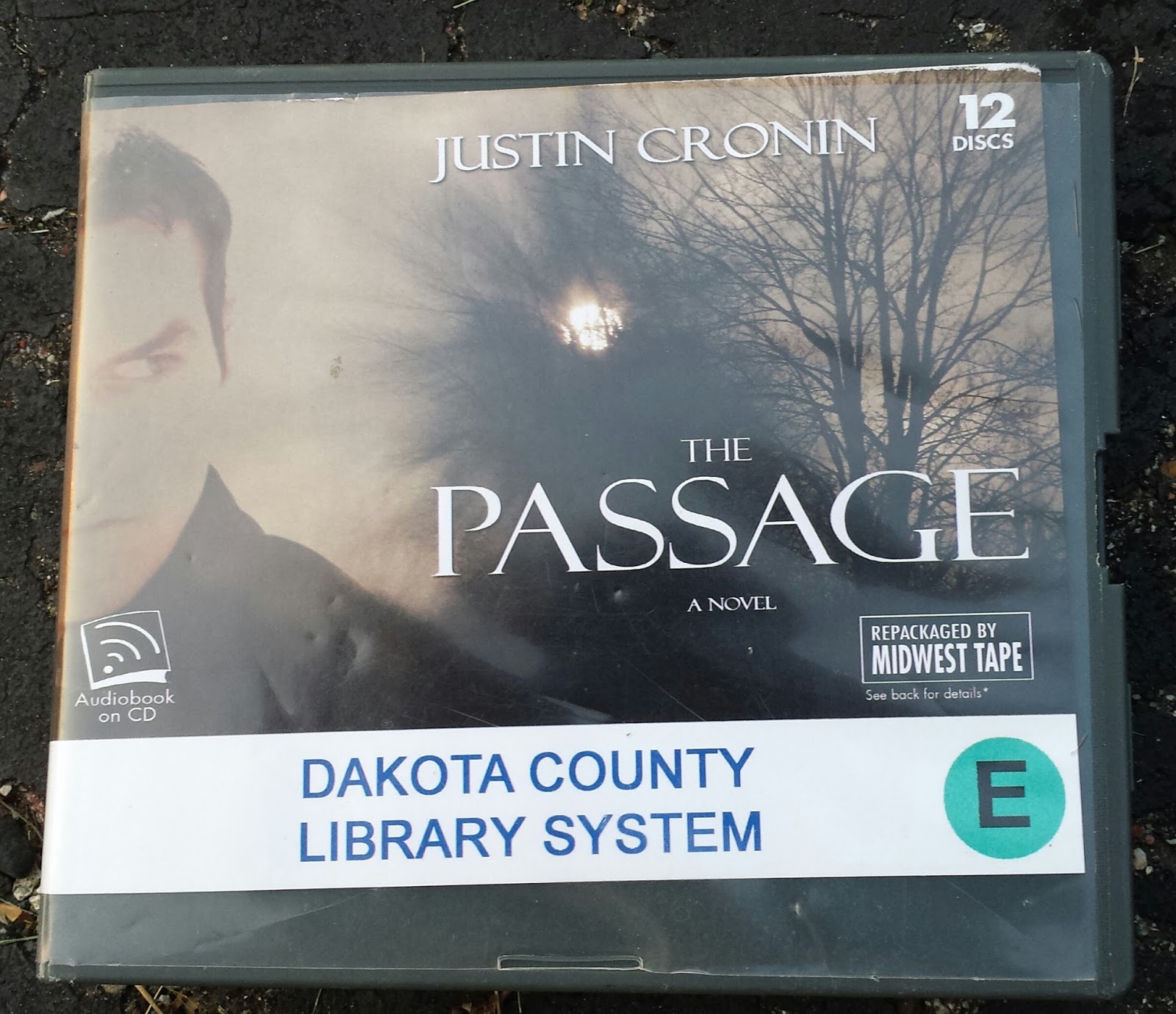
"The Passage" by Justin Cronin

Tami read this book a while back and had planned to read the sequel. We picked up this audio book to refresh her memory and get me up to speed.

Summary: In the jungles of South America, a strange virus infects an academic team. The U.S. military quickly establishes a program to research the virus and weaponize it. The virus brings on a dramatic transformation in the victim that turns them into fast, nocturnal blood-suckers. Twelve death-row inmates were the first guinea pigs and did not show the desired effects. One more subject was given the virus, but before the results could be analyzed, the facility fell and the subjects escaped. Quickly the whole continent was infected and the life as we know it is gone.

Years later the survivors struggle to make a living in a world filled with the infected creatures, called virals. Bright lights protect the isolated colony of survivors, and everyone has a job to do. But there are signs that the colony cannot last. Slowly, a plan comes together and an adventure begins.

What I Liked: There's a lot to think about in this book. The virals are fascinating, the characters are well rounded and the plot is compelling.

Tami enjoyed the layout of the plot.  The first half of the book is back-story to the action that takes place 100 years in the future.  The back-story written in such a compelling manner that it might just be my favorite part.  There is something morbidly fascinating about watching society as its known fall.

What I Didn't Like: I realized too late that this is the abridged version. I then wondered what scenes I missed. Also, my favorite character died really early.

Tami thought it was scary, and there were parts that turned my stomach.  But each bit of the plot was necessary to advance the story, so I suffered through it.

Rating: This has all the right elements of a post apocalyptic story. I recommend it.

Also Read by this Author: None.

Reviewed by: Nick (with Tami chiming in)