Showing posts with label non-fiction. Show all posts

Tuesday, April 26, 2016

"The Cosmic Connection" By Carl Sagan

I found this book in a used book store and bought it simply because it was written by Carl Sagan.

Summary: This is a non-fiction book in which Sagan discusses projects and theories that he is familiar with regarding our place in the universe and the possibilities of contacting other intelligent life. Surprisingly for a book written in the 1970's, it is a nice introduction to all the major ideas on the topic. For example, he discusses Dyson spheres, which still comes up today as an exciting futuristic idea. Similarly, he spends time considering the SETI program, both in terms of finding evidence of other life and ways that others might find us.

One gem is his discussion of the plaque added to Pioneer 10 as a message for any extra terrestrials that might discover it in flight. Sagan was the person who made it happen on this mission and several following missions. His insight as to the intentions and the process of designing the plaque is something you likely wont find in any other book.

He shares his experiences studying dolphins, giving insight into the difficulties in communicating with a totally different but intelligent lifeform. The most persuasive point he makes in arguing that dolphins are in fact intelligent is that they have learned several words in English, but not a single human has learned any Dolphin. It is a fascinating idea to think that maybe dolphins are as smart as we are, and the thing that distinguishes us from them is our manual dexterity and ability to use tools.

I am also extremely fond of Chapter 37, where he begins his Starfolk narrative. Chapter 37 is subtitled A Fable and recounts the history of us, from the beginning to today. It places us right here and now, in context, cleanly and clearly, with the grandeur of myth, but without the falsehoods.


What I Liked: I love the feel of Sagan's writing. He is 100% that one professor you had that was able to pack profound knowledge into a casual conversation. His books feel like a transcript from a musing lecture with the rigor of a researched publication.

What I Didn't Like: I have no complaints about Sagan.

Rating: Recommended.

Also Read by this Author: Pale Blue Dot, The Demon-Haunted World.

Reviewed by: Nick


Tuesday, January 5, 2016

"Cooking as Fast as I Can" by Cat Cora

Image via GoodReads
I don't even know how I came across this one.  It magically appeared in my library queue so I read it.  (Or at least that's my story.)

Summary:  I'm a sucker for a biography for a lot of reasons; I like to learn about people's lives without actually having to interact with them.  I'm endlessly fascinated by seeing what drives the people at the top of their game to keep pushing for more.  And I love me some good old fashioned drama.  Cat Cora's first biography doesn't disappoint.

Raised in the deep South, Cat Cora had a childhood that set the framework for her meteoric rise in the world of fine dining.  Cora was adopted by parents that showed her love and support, taught her to work hard and think for herself.  Her dad taught history, her mom was a nurse, and her brothers helped her raise hell during the long hot summers.  While her childhood was mostly a good one, full of food, love and family, it was also haunted by her repeated molestation by the son of a family friend.  Cora's childhood trauma triggered a need to prove herself as worthy in all she did.

"Cooking as Fast as I Can" is a painfully honest look at Cat Cora's life, from her childhood nightmares to her single-minded drive to cook in the top kitchens in the predominantly male dominated world for haute cuisine.

My Thoughts:  I've read a few celebrity chef biographies and one thing I've noticed about the folks that have made a name for themselves in the fine dining industry is that they have a definite cocksure swagger to their personalities.  Maybe when you've hit a certain level of excellence at something you just know your shit.  Or maybe the brutal hours and constant drive to be different, new and noticed drives a person to be heard.  Whatever it is, I find the almost forceful self-assurance both compelling and exhausting.  Cat Cora definitely has this swagger, which I noticed the most when she talked about cooking and women.

I enjoyed this book.  It had a good pace, was candid in its telling and was fascinating to read.

Rating:  This is a nice book to pick up if you're a foodie, fan or iron chef, or curious about the lives of the famous.

You May Also Like:  "Kitchen Confidential" by Anthony Bourdain, "My Life as a Professional Eater" by Gail Simmons, "Yes Chef, A Memoir" by Marcus Samuelsson, 

Reviewed By:  Tami


Tuesday, November 17, 2015

"When Books Went to War" By Molly Guptill Manning

I heard an interview with the author on the radio and a few months later saw the audiobook at the library. 

Summary: As the Nazis gained power they campaigned against certain books, hosting book burnings and eventually banned books outright. As the allies challenged the axis on the battlefield, there was a parallel conflict building up. In America librarians and others united to fight the fascists in the war of ideas. As the Nazis burned them, the Americans distributed them.

In the beginning there were civilan book drives with drop offs all across the nation. They accepted all books and worked to get them into army training camps and deployment centers so that soldiers could select a title and read at their leisure. The idea was to show that America supported freedom of the press and to remind soldiers what they were fighting for.

The book drives proved inadequate because people dropped off books that were unwanted and impractical, especially the large hardcover editions that could not be carried by a soldier in the field. The government then organized a program to publish special Armed Services Editions of various titles selected by a council. The books were custom designed to fit in a soldier's pocket and stay with him until he was done reading it. Many consider the program to be reason millions of people became lifelong readers after the war.

What I Liked: The importance of books in World War II is great. I love the idea of a council whose only job is to get as many books into soldier's hands as a way to fight the enemy.

What I Didn't Like: This book has no story arc or protagonist. There is no compelling build up to keep you reading. If this wasn't an audiobook I am not sure I would have finished.

Rating: If you have an interest in WWII or book history, you might like it, otherwise, probably not.

Also Read by this Author: None.

Reviewed by: Nick
Tuesday, October 20, 2015

"Going Clear" by Lawrence Wright

I heard about this book when it was being made into a movie. Then I saw it on it the shelf at the library and picked it up.

Summary: This reads like an in depth expose on the church. The book explores the biography of Hubbard and the history of the church from its founding. It starts with a look at Hubbard's life as a science fiction writer and naval officer. It reviews deception in his service record and his injuries. It then goes into the creation of dianetics which evolved into the modern church. There was a significant period where the church was mainly sea-going and struggled with prohibitions in several countries. They endured a long legal battle with the IRS and governments in Europe.

Eventually, the church is accepted as a legitimate religious organization and grows. Much of their energy is spent on recruiting and maintaining celebrity members including a strong presence in Hollywood offering classes and workshops for movie stars. This book takes a close look at how the church treated Tom Cruise and John Travolta. It also has a lot to say about Paul Haggis, a famous screenwriter, producer and director. It examines claims of physical and psychological abuse in the Sea Org (the clergy) and the many practices of the church that have given it the terrifying reputation it has today.

What I Liked: Before this book I did not know much about Scientology beyond the rumors I heard from atheists and critics of the church. After this book I have a better grasp of what the church is like on the inside and what were major events in its timeline.

What I Didn't Like: This book was exactly what I hoped it would be. The only downside to an audiobook is that I don't have the same ease regarding citations.

Rating: Very informative. I recommend it for anyone who wants to know more about Scientology.

Also Read by this Author: None.

Reviewed by: Nick

Tuesday, June 9, 2015

"Factory Girls" by Leslie Chang

I heard this book mentioned in a discussion about the modern economy and then saw it on the library shelves.

Summary: Leslie Chang is an American journalist who spent several years conducting interviews in China. The main focus of this book is on the rise of factories and the migrant workers who fill them. She interviews several workers and a few of them maintain contact over the years even as they change cities and industries. Chang goes into detail regarding their working conditions and their social lives. She tours the various places of their lives, including taking a trip back to the farm from which one of the migrants was born. She highlights the ups and downs, including how most migrants seem to see factory work as an opportunity to rise economically. They are constantly improving skills and jumping from job to job, hoping to make it big. Chang also talks about the control that the factories have over workers, including deciding where they sleep, how many hours they work and even if they are allowed to collect their last paycheck.

Chang also takes the time to explore her own past and contrast it with the workers. Chang's great-grandfather was regionally powerful before the communist revolution. He was a government official and lived in a large compound, and controlling a large amount of land. Her grandfather was an important mining engineer during the Japanese invasion and eventually assassinated during the cultural revolution. Her family moved to the United States and Chang sees similarities in her personal migrant story and the girls who work the factories.


What I Liked: This is a good long perspective on the changes in China without feeling like a defense of any particular argument. She reports what she finds and lets the reader draw their own conclusions. This is the most comprehensive book I have read on China and I found it enlightening.

What I Didn't Like: Even though she compares the two themes of the factories and her family, it still felt like maybe they should have been two different books.

Rating: Recommended.

Also Read by this Author: None.

Reviewed by: Nick

Tuesday, November 25, 2014

"Packing for Mars" by Mary Roach

I selected this book as it looked like an interesting book on space travel and the possibility of sending humans to Mars.

Summary:  This book is an exploration of all the questions you wanted to ask regarding space travel, but couldn't seem to find a NASA article on the subject. Mary interviews several people connected to the Japanese, American and Russian space programs in order to learn more about the effects of zero gravity, astronaut selection and the engineering of spaceships. Most of the book is historical, in that it uses information from the Gemini, Apollo missions and related research from that time period. 

Roach covers a variety of topics including space food, space toilets, space sex, space clothes, space bathing and much more. She also explores rumors of space scandals that NASA has tried to downplay. This is a book written by someone genuinely excited about space travel, but bored with the press releases and official statements. Roach wants to know all the dirty details about life in a spacecraft and shares her findings in this book.


What I Liked: This book is full of side comments in the footnotes. Roach can't help but add little tidbits here and there, like this excerpt from a discussion on drinking while in a spacesuit: "Consumed intravenously, Tang causes joint pain and jaundice, though fewer cavities."

What I Didn't Like: This book did not really look at the possibility of going to Mars. It should have been titled "Packing for the Moon (or ISS)". I had thought it would look into the science of a Mars colony.

Rating: Highly recommended, but for mature readers only as it includes topics that are generally considered inappropriate for children.

Also Read by this Author: None.

Reviewed by: Nick

Tuesday, November 11, 2014

"Endurance: Shakleton's Incredible Voyage" by Alfred Lansing

I selected this audiobook because I was not familiar with the details of Shackleton's expedition. I knew he was an antarctic explorer of some kind, but that was all.


Summary: This is the story of the Imperial Trans-Antarctic Expedition headed by Sir Ernest Shackleton. Lansing has interviewed crew members and read their diaries to piece together the story from start to finish. The story is told in dramatic fashion to match the drama of the journey. It is as though at every turn nature is trying to wipe these 28 men off the bottom of the map and it is only by hard work and a dribble of luck that they make it back to civilization.

As the story is now 100 years old, I can't be accused of spoiling it, so here's the basic plot. Shackleton is looking to be one of the great First's on the icy continent. Someone was already the first to reach the pole, and so he is planning to be the first to trek across the whole landmass. They are to go to the pole and then leave the continent on the other side. A separate expedition is organized to stash supplies on their exit route from the pole so that they need only bring half the gear with them. They take the ship the Endurance into the antarctic ocean and are trapped in ice. They eventually abandon ship and make camp. Shackleton and a small team then takes a lifeboat back across the ocean in search of help. This book follows the hardships and accomplishments of the men who stayed behind and the men who risked everything to save them.

What I Liked: This story has all the terror and excitement found in a sci-fi or fantasy book, and with the added bonus of being true! It is told in a very clear and direct manner so that you feel like the adventure is unfolding before you. Each chapter I was imagining myself alongside the men and wondering what I would do in their shoes. I got excited when they had good luck and became worried when things grew worse. Lansing is great at making the scene real.

What I Didn't Like: N/A.

Rating: Must Read.

Also Read by this Author: None.

Reviewed by: Nick

Tuesday, October 28, 2014

"Hitch-22" By Christopher Hitchens

I selected this audiobook because I have watched Christopher Hitchens debate many people on television and youtube, but had not read any of his books. 

Summary: This is a memoir in which Hitchens reflects on all the stages of his life and the people and places that played a major role. Interestingly, this is mainly focused on his professional and political life, avoiding much of the personal. He describes his relation with his parents, who he oddly refers to as Commander Hitchens and Yvonne. He talks about growing up as a student at a British boarding school and becoming politically awakened. As a young adult he quickly becomes very active in the worldwide socialist movement and visits many countries as part of solidarity actions, including working on a farm in Cuba. He also got an early start at his lifelong profession of writing. Hitchens wrote articles for his entire adult life and was able to participate in the grand discussions that surround major political events and catastrophes. He argued strongly with people on the right and on the left, trying to push forward his own idealist views of a better world.

He was uniquely positioned as an established liberal who supported the war in Iraq. He made several trips to the country and was convinced that Saddam Hussein had to be taken down, which put him at odds with the anti-war movement that surrounded him. He also became famous as one of the Four Horsemen of the Non-Apocalypse for speaking strongly against religion. He was active in many causes throughout his life and he discusses them with a precision that convinces me he kept a detailed diary.

What I Liked: I learned a lot about Hitchens' life before youtube and how he established himself in the political and journalistic spheres as someone worth listening to. It gives me a lot of context in understanding his positions in various debates and made me think about my own positions.

What I Didn't Like: Hitchens was married at least once, and had at least one kid, but beyond that I know almost nothing about his personal life after reading this book. It makes him feel incomplete.

Rating: Not for the average reader. Great for political science majors or fans of Hitchens.

Also Read by this Author: None.

Reviewed by: Nick

Tuesday, September 23, 2014

"American Chronicles World War I" by National Public Radio

I selected this audiobook because I am a regular listener of NPR and generally curious about World War I (partly because of watching Downton Abbey and partly because of an amazing history teacher in high school who made the class play a complicated homemade game which demonstrated quite effectively how the Great War began. 

Summary: This is an audio collection put together by the NPR staff. As far as I can tell, this is only available as an audiobook, which kind of makes me feel like it's not a "real" book, but whatever.

This collection is made up of a series of interviews with journalists, historians, authors and WWI veterans, each talking about some aspect of the war, or its legacy. They cover a wide range of topics including the Battle of the Somme, outbreaks of peace, airplanes, the sinking of the Lusitania and the Bonus Army in Washington, DC. The interviewers are all regular journalists or hosts found on NPR shows, which made me sometimes forget if I was listening to the radio or a CD.

WWI is such a strange war because it is a clash of the old and the new. The soldiers seem to be from an older age, but their weapons are entirely modern. When I think about it, I imagine Civil War soldiers with machine guns and 1400 pound artillery shells. Whole cities were wiped off the map and tens of thousands killed in astonishingly short battles. And this mass combat has left its mark on the world today.

As a side note, I want to say this book inspired me to watch the 1916 propaganda film The Battle Of The Somme which includes over an hour of genuine footage from the battle, mostly from the artillery units. I gave me a haunting feeling to stare into the faces of young men who lived (and many died) nearly 100 years ago. 


What I Liked: I learned a lot from this audiobook and felt that the interview method was a very effective way to present this information.

What I Didn't Like: They did not make much of an effort give a comprehensive timeline or overview of the war. They highlighted interesting parts of it, but assumed the listener would be able to look up whatever additional information they wanted.

Rating: This is a perfect example of why I love NPR. I am going to check out their other American Chronicles collections.

Also Read by this Author: None.

Reviewed by: Nick

Tuesday, September 16, 2014

"The Wordy Shipmates" by Sarah Vowell

We picked this audiobook based on the fact that I like authors who contribute to public radio programs and Tami has a copy of this book in softcover, but has not gotten around to reading it.  

Summary: This book is a non-fiction account of the colonies in and around the land that became Massachusetts. Sarah Vowell spent years reading primary sources from the era and visiting sites important to the history. The source she explicitly refers to the most is the personal diary of John Winthrop, who played a central role in the founding and managing of the Massachusetts Bay Colony. Vowell discusses the lives of the colonists before they ever left England, and what it was like to sail across the Atlantic. She quotes often from the men and women, directly from their written words. She discusses the early years of the colony, including the life of the Charter, the religious disagreements and the banishments doled out for those who were deemed a danger to the colony. The native Americans also play a big role in this book, for their continuous relations with the Europeans. At times they were allies and at times they were at war. Vowell explores the reasons for both, with a personal interest since she can trace her descendants to both sides of the ocean, pre-Columbus.

What I Liked: Vowell let a lot of the historical figures speak in their own words a lot, using a lot of direct quotes from letters, diaries and texts written at the time. I learned a lot about the colony, as I never really studied this particular group in school and felt no compulsion to investigate before this book.

What I Didn't Like: This audiobook has multiple voice actors, including Vowell herself. Each character has a unique actor for when they are quoted. It was fine when they recited a paragraph or more, but Vowell often would quote a single word of phrase and it was really disorienting to hear two voices interrupt each other while working to finish a sentence. I wish that they had handled it differently. Of course, you wont notice that if read the book.

I also found the material was presented in a form that reminded me of a history lecture. Tami did not finish the book, and I doubt I would have been able to finish without the audiobook setting the pace for me.

Rating: Skip it, unless you are a fan of Sarah Vowell.

Also Read by this Author: None.

Reviewed by: Nick

Tuesday, August 19, 2014

"Don't Know Much About Geography" by Kenneth C Davis

We picked up this audiobook from the library because we both find geography interesting and and thought it might be fun.

Summary: This is a question and answer format text that goes over a wide variety of geography questions. It is broken up into sections called lessons and feels very much like something a substitute teacher might use when the geography teacher was out sick and didn't leave any instructions.

A variety of questions are asked, one at a time. Some are really bizarre and others are open-ended. The author then answers each question to the best of their ability, including historical references. There is no plot to this book, but instead is an FAQ. The level of questions are around high school, which for many of them meant I knew the answer already and for others it meant I had a vague memory of learning about the topic, but let the knowledge fade over the years.

What I Liked: Some of the information was very interesting. And the author had a subtle political bias that matches my own.

What I Didn't Like: I would have preferred something with a story arch, not just a series of questions. I have read very informational books with compelling narratives holding everything together and had hoped for that with this book.

Rating: Might be interesting for k-12 students, but then again, we have the internet now.

Also Read by this Author: None.

Reviewed by: Nick

Tuesday, May 6, 2014

"Ice Bound" by Dr. Jerri Nielsen with Maryanne Vollers

We selected this book it combined my interest in science and Tami's interest in autobiographies. 

Summary: This is the story of Dr. Jerri Nielsen, an emergency room doctor who lives in Ohio. She talks about her personal life and how her family fell out of her reach. This moved her to a mental space where she was lost and uncertain about her future. She decided to apply to be the winter doctor at the Amundsen–Scott South Pole Station on Antarctica. She describes the process of getting ready for a year long stay at the pole and how one gets there. She talks about the summer crew she met when she arrived and the "night shift" when the summer folks flew out. Once the summer ends, the team is in total physical isolation without any planes able to safely land or takeoff at the pole. Even their communications is limited by the brief windows of satellite reception available at the pole. They learn to make do with what supplies they have and keep a very close eye on all critical systems. She talks about the kind of people who choose that sort of job and way people behave while they are down there. There were 41 people total on the winter crew and they got to know each other very well.

The doctor describes the sorts of training she received before and during her stay. As an emergency doctor she saw a lot of different injuries, but at the pole there would be only one doctor who would be expected to treat any and all injuries. Unfortunately for her, she ended up becoming her own patient! Trapped on the station with limited supplies, Nielsen led her own medical treatment with the assistance of specialists via satellite. Eventually, after deciding her life was in danger the US Government decided to risk a dangerous flight to the south pole in the middle of winter!

What I Liked: It is always interesting to hear people talk about their lives, especially when they are doing something exciting in an exotic place. I learned a lot about the south pole and doctors from this book.

What I Didn't Like: We listened to the audiobook, which was read by the author. She is not an experienced voice actor, so it was distracting.

Rating: This was a very good autobiography.

Also Read by this Author:  None.

Reviewed by: Nick

Tuesday, April 22, 2014

"The Demon-Haunted World" by Carl Sagan

I found this book at a used bookstore and picked it up because it was written by Carl Sagan.

Summary: This is Carl Sagan's last book, and it is, rightly, a wide ranging text covering many of Sagan's biggest ideas. This is Sagan trying to make one grand argument that took a lifetime to develop. 
This is an excerpt from the book where Sagan puts
forward a clean argument for skepticism. It is presented
so neatly, I had to share it.
The argument in this book is that science education will save us and pseudo science will be our undoing. He takes the time to address each form of popular pseudo science in turn and evaluates the evidence for and against claims. He looks at alien abductions, astrology, psychics, witch trials, false memories and more. He puts each claim under scrutiny and shows how ridiculous they really are. As the claims dissolve, he replaces them with reasonable explanations and rational thought. This leads into a discussion on the value of skepticism and how it helps us get to the truth of the matter and avoid being taken for fools. He even has a chapter on The Fine Art of Baloney Detection, which gets right to the point. Throughout the book, Sagan tells stories from his life and from the history of science, each selected for its ability to highlight the point being made. Toward the end of the book he looks to the future of our civilization. We now have the machines to destroy ourselves several times over, and pseudo science gives us the reasons to do it. We need skepticism and wonder in order to survive. With these two tools of thought we can make it through.

What I Liked: I liked the way Sagan would explain each pseudo scientific idea respectfully, then explore it skeptically. Many of the ideas were more popular in the 90's, but there is still a lot of such claims today. I also liked his autobiographical parts and the stories.

What I Didn't Like: It was too short.

Rating: This is a Must Read. I consider this one of the best non-fiction books I have ever read.

Also Read by This Author: Pale Blue Dot

Published: 1997

Reviewed by: Nick


Special Note: Cosmos A Personal Voyage was hosted by Carl Sagan in 1980 and talks about a lot of the same ideas. The remake, Cosmos A Spacetime Odyssey, is currently being aired on Fox and National Geographic Channel, hosted by Neil deGrasse Tyson. I recommend it!

Tuesday, April 1, 2014

"Kitchen Confidential" by Anthony Bourdain


We selected this audio book based on the author and our interest in autobiographies. 

Summary: This is an autobiographical account of Bourdain's life in commercial kitchens. He got his start in P-town working the wild pirate kitchens by the shore where he fell in love with the high stress world of cooking. He then went to the Culinary Institute of America to get some formal education on his resume. He then describes the fast-paced world of kitchen hopping. He would move from one short-lived place to another, constantly networking and learning new skills. He describes the people he met in his adventures, the cooks, chefs, owners and vendors who make the business possible. He also provides a fascinating look into the typical day of a chef. And as the name implies, he divulges secrets of the restaurant business that other might wish he hadn't said. Some people who read this book might change their eating out habits. You also get a taste for his life right when he starts to make it big.

What I Liked: Bourdain reads the audiobook, and for those of you familiar with his TV work you know he is very good at reading scripts. It made the experience more authentic having him read it, and he did a great job. He is also brutally honest with regard to his own shortcomings. Bourdain does not flinch from blaming himself for his mistakes.

What I Didn't Like: Honestly, I don't know what to say. No complaints.

Rating: This is a wonderful book. I recommend it.

Also Read by This Author: None.

Published: 2000

Reviewed by: Nick

Tuesday, March 18, 2014

"A Walk in the Woods" by Bill Bryson

We selected this audiobook based on our success with a previous audiobook, Lost Continent, by Bill Bryson.

Summary: This is an autobiographical story about the time Bryson hiked the Appalachian Trail (and no, that is not a euphemistic reference to Mark Sanford). Bryson decided to start in Georgia and walk his way up to Maine. He talks about preparing for his trip, shopping for gear and foodstuffs. Worried about being alone in the middle of the forest, he recruited his friend Katz to come with. They overcome a variety of obstacles,  but physical and mental. They fight all kinds of weather, make mistakes and come to moments of realization. The whole book is littered with interesting analysis regarding the management of the National Forest Service and the Appalachian Trail Conference. He describes the trail, its amenities and the scenic points. He recounts the history and construction of the trail and how it has shaped the region. This edition was read by the author, who happens to do a very good job of it.

What I Liked: Personally, it reminded me of my two teenage trips to Philmont Scout Ranch where I hiked two weeks at a time in the Rockies of New Mexico. I remembered what it was like to carry your life on you back and wonder if you really needed all that food or a sleeping bag. Also, Bryson has a fantastic sense of humor typically found in Britain, which I love.

What I Didn't Like: They don't accomplish everything they had hoped for, and I felt sad for them.

Rating: Wonderful! Totally worth the read. 

Published: 1998

Also Read By This Author: Lost Continent.

Reviewed By: Nick

Tuesday, February 18, 2014

"The Butler" by Wil Haygood

This audiobook was selected because of its historical content. 

Summary: Shortly after the 2008 election of Barack Obama Wil Haywood wrote an article called A Butler Well Served By This Election. The article focused on Eugene Allen, a black man who served as a White House butler over 34 years for 8 presidents. The reason Eugene's story is so compelling is because he witnessed the changes which happened during the civil rights movement. From the article a 2013 movie was made, called The Butler staring Oprah Winfrey and Forest Whitaker. 

Presumably, this book was to be the story of Eugene Allen in greater detail than a short article could cover. Instead, this book is the story of Wil Haywood and how he came to meet Eugene and write the article. It is also the story of Eugene attending Obama's inauguration. The second part of the book is a history of black cinema which leads into the story of how The Butler was filmed and produced.

What I Liked: It was interesting to hear the story of Eugene Allen, Wil Haywood and black cinema.

What I Didn't Like: We had expected there to be a more in depth look into Eugene's life, instead the book focused more on how the author was inspired by Eugene's story. It felt a lot like an infomercial for The Butler movie. It would probably be better to just watch the movie. 

Rating: Skip it.


Also Read By This Author: None. 

Reviewed by: Nick

Tuesday, January 7, 2014

"Lies My Teacher Told Me" by James W. Loewen

 Originally, my brother gave me this book years ago. I recall being on a plane headed for South America reading it. I do not recall seeing it when I returned. Whatever happened to the poor text is forever a mystery, but it inspired me to pick it up as an audio book for Tami and I to listen to on the way to work. 

Summary: Loewen selected the twelve most used textbooks in high school American History classes. He then spent years reading and analyzing all twelve and talking with college students in his classes. This book is the result of that research. Loewen's major conclusion should be obvious from the title. He argues strongly that American History textbooks are not vehicles for historical facts, but a way for students to learn the multitude of American myths that our nation has come celebrate. He criticizes textbooks for pretending that good old USA is always the good guy, no matter what. Similarly, textbooks deify our founding fathers and other famous figures by either hiding their crimes or justifying them in bizarre ways. He spends a lot of the book clearing up many of the big myths to give the reader clear and factual information. He also goes into the metadata, discussing the amount of space devoted to different purposes, for example comparing number of words used for the War of 1812 and the Vietnam War and other such events. He talks about the historians who work for the publishers to show that many of them have published very truthful academic work outside of school textbooks, and goes into the dynamics of textbook publishing to show how a person fully aware of the truth might end up echoing the same old myth.

What I Liked: This book is a refreshing look at the way in which history classes are used for reasons other than teaching history. I also learned a lot from this book about what really happened when Columbus came to America, bringing with him an endless tide of Europeans.  

What I Didn't Like: It was a little outdated. This book was published in 1994 and the success of the internet has made myth-busting both easier and harder. This book is written right at the end of the non-internet era and so it never comes up in the discourse.

Rating: This is a must read if the only thing you know about history is what you learned in school.

Also Read By This Author: None.

Reviewed By: Nick

Tuesday, November 5, 2013

"Rocket Men" by Craig Nelson

This book appealed to me because I am becoming very interested in space travel and colonizing other worlds. I didn't know a lot about the Apollo program before this book and wanted to know more. I borrowed it from the library and started listening to it with Tami, but she quickly lost interest.

Summary: This dense, 17 hour audiobook has everything you could want to know about humanity's journey to the moon ... and everything you didn't. This is a detailed account of the Gemini, Mercury and Apollo programs, including a deep look at the origin of rocket science. All the big names get a part, including Goddard, Von Braun, James Webb, Kennedy, Armstrong, Aldrin, Collins and plenty more. It goes into the politics of World War II, the cold war and domestic support for space exploration. It talks about rocket science and surviving in space. It goes into the lives of the astronauts and uses a lot of quotes from primary sources. It delves into the fears of the NASA employees and what they did to minimize the dangers. This book is a truly comprehensive look at our trip to the moon.

What I Liked: This taught me everything I know about moon trips. I feel like I can talk intelligently about NASA history now that I have finished this book.

What I Didn't Like: It felt a lot like a history lecture, and not a particularly great one. It had a whole heck of a lot of quotes, which are awkward in an audiobook. I glossed over parts of it without really listening.

Rating: Tami didn't make it past the second disc. If you are really curious about the moon missions it is a good choice, but if you are ambivalent,  avoid this book.

Other Books Read By This Author: none

Reviewed By: Nick

Tuesday, October 1, 2013

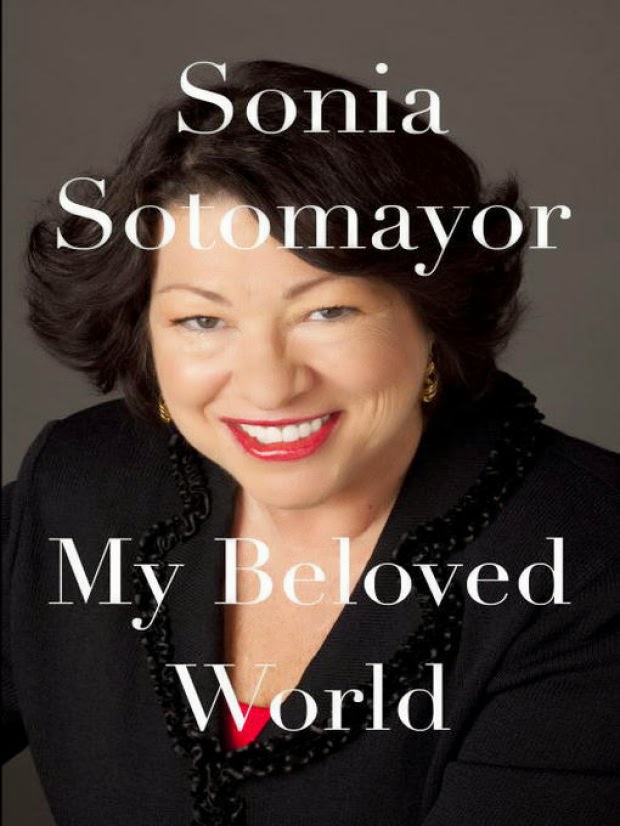
"My Beloved World" by Sonia Sotomayor

Summary:  It's hard to imagine a Supreme Court Justice growing up in the projects of the Bronx, but those are the roots that shaped Sonia Sotomayor into the first Puerto Rican Supreme Court justice in the United States.

This autobiography recounts Justice Sotomayor's life from her earliest memories dancing at house parties hosted by her glamorous and superstitious Abuelita, her diagnosis of juvenile diabetes in grade school (at the time a death sentence), her struggles to learn English and get passing grades in Catholic school, the hard work that brought her to the Ivy League, a failed marriage, working with Prada and her eventual road to public service.

What I Liked:  I was pleasantly surprised at how open this book was.  Sotomayor did not shy away from superstition, alcoholism, the prejudice she faced in the era of affirmative action or her views on having children.  The story was told as a narrative, in more or less chronological order and with emotion that felt both genuine and wise.

Whats Drove Me Nuts:  Not much!  I would have liked to read more about Sotomayor's professional life, but I understand why she spent so much time on her formative years.  It was inspiring to read how someone who literally came from nothing managed to work her way to the top of her profession.

Rating:  Read it!  Really, this book was a bit like reality TV, but where you root for the main character to win the whole shebang from the first introductions.

Reviewed By:  Tami

Tuesday, September 10, 2013

"Never Have Your Dog Stuffed" By Alan Alda

Tami and I watched every episode of the West Wing together (a show where Alda has a big supporting role) and we both grew up with M*A*S*H on the television. We decided that Alda would be interesting, and we were right. We picked this one up as an audio book and listened to it in the car.

Summary: This is a memoir in which Alda reflects on his life from his earliest memories as the son of a travelling burlesque comedian all the way up through the end of Scientific American Frontiers in 2007.  The story is told through vignettes of his unique and unconventional boyhood and as well as through well thought out analysis of what it means to be a comedian, an actor, a host and a "civilian".  Alda reflects on his father, who was a mentor and rival and tries to come to terms with his mother who suffered from a near debilitating mental illness.  Alda reminisces about supporting his family through "professional" gambling while taking any acting gig he could get and his time at M*A*S*H where he was able to hone his writing skills and define himself as one of the most well remembered television actors of his time.

What We Liked: Alda has a lot of experience writing and a very good sense of humor. The entire audio book was fun to listen to. There were a number of jokes and funny stories mixed in with more serious memories, including boarding school, his thought on religion and his efforts during the equal rights movement. We learned a lot about the actor who we only knew as the man on the screen.

What We Didn't Like: He didn't talk about his time on the West Wing!

Rating: If you like Alda as an actor, you should read this book.  If you don't know who he is, you should read this book

Also Read By This Author: Nothing yet.

Reviewed By: Nick and Tami.