Tuesday, December 29, 2015

"Game of Thrones" by George RR Martin

I was introduced to this story through the television show and was looking for a way to try my library's ebook checkout system. I saw this title right away and knew it would be a good read. I downloaded it and read it like an ordinary ebook, but the special library app made sure I "returned" it at the end of the allotted time. 

Summary: In the land of Westeros there are seven kingdoms united together under one king. Each region is ruled by a powerful family and is divided again among lesser lords. What makes this story exciting is that political power ebbs and flows from lord to lord depending on hundreds of decisions, strategies and plots.

This book spends most of it's time centered around Ned Stark and his family. He is the Lord of Winterfell and was critical in helping the king gain the throne from the Mad King who was so horrible that one of his own guards finally killed him. After some key battles were won, King Robert was crowned. And now the king's highest adviser is dead, so Ned has been asked to replace him. As Ned learns more and more about what is happening in the capital, it looks worse and worse.

Every piece is moving in this chess game and there is no way to anticipate how it will all play out. Those of you who have seen the show, it is basically the same story as season one. The big difference with the book is that you get to spend a lot of time inside the head of each character, watching them analyze their situations and weigh the pros and cons of action. In the show you see what they do, but in the book you read why they do it.

What I Liked: I loved the show, and I am glad that the book has the same feel without making me feel like I have to say one is better than the other. Both are amazing.

What I Didn't Like: I'm not sold on the library ebook system. I still can't get over the idea that my software is due back so that someone else can read it.

Rating: Must Read.

Also Read by this Author: None.

Reviewed by: Nick

Tuesday, December 22, 2015

"The Fellowship of the Ring" by JRR Tolkien

I read this book in middle school, and got half way through the Lord of the Rings trilogy. I stopped because I found it depressing and the elven was unintelligible, but now that I am an adult nerd, I feel like I should have all four of them under my belt, and not just the movies. At the library I saw all four in audiobook format and decided I could finally finish the series. 

Summary: This story takes place several decades after The Hobbit in which Bilbo goes on an adventure and happens to find a very useful ring. It is The Ring. Centuries ago, Sauron gave out rings of power to various factions hoping to win their trust and loyalty. And he had a special secret because he made one more ring that was designed to control the others. Sauron lost the ring in battle and it changed many hands until finally reaching Bilbo, a small hobbit in the Shire. Young Frodo inherited the ring when Biblo decided to leave the Shire right around the time Gandalf began to understand the true power of the thing.

As Sauron grows in power and threatens the lives of every race, Gandalf the Grey thought on the fate of the ring for some time, finally deciding that any plan which did not include destroying was too dangerous. Unfortunately, the only way the ring could be destroyed was to drop it in the pits of Mordor where it was forged. The rest of the book is assembling a team to bring the ring to Mordor and destroy it before the wraiths of Sauron can seize it.

What I Liked: Since I liked The Hobbit I appreciate any book in the same universe. Also, this is quintessential fantasy with elves, dwarves, wizards and brave knights. This first book in the trilogy is very hopeful and eager. The characters are worried, but motivated to complete their mission. 

What I Didn't Like: Some of the decisions made by the wise folk are a bit confounding. One option they have is to send the ring to the opposite side of the world, and they figure that Sauron will catch up with it some day, so that's not good enough. It seems to me, that if it delays the problem several generations, its still a win, whereas bringing the ring straight into Sauron's fortress hoping to destroy it seems more dangerous. Also, while I am complaining, Tom Bombadil is older than the world, and bends the world to his will, yet he can't be bothered to help destroy the ring. I mean, he could have totally saved the day without breaking a sweat!

Rating: Recommended.

Also Read by this Author: The Hobbit.

Reviewed by: Nick

Tuesday, December 15, 2015

"The Hobbit" By JRR Tolkien

I read this book in middle school, and got half way through the Lord of the Rings trilogy. I stopped because I found it depressing and the elven was unintelligible, but now that I am an adult nerd, I feel like I should have all four of them under my belt, and not just the movies. At the library I saw all four in audiobook format and decided I could finally finish the series. 

Summary: This book takes place several decades before the Lord of the Rings series and is not technically part of the series, though it does introduce a few characters and provides a context for the trilogy that comes later.

In this book, Bilbo Baggins is a hobbit living by himself in a nice hole safely placed in the Shire. He is tricked by Gandalf, a mysterious old man known for his amazing fireworks and said to be a wizard, who invites a thirteen dwarves to his hobbit hole. Eventually, Bilbo figures out that he is hosting the planning meeting for an expedition to the Lonely Mountain so that it might be reclaimed for the dwarves.

Bilbo joins Thorin Oakenshield and his dwarves on a dangerous adventure eastward. They meet elves, trolls, goblins and eagles as they navigate through the Mirkwood. At one critical juncture, Biblo finds the Ring which eventually sparks the events in the trilogy.

What I Liked: I am a gamer, mostly Dungeons and Dragons style games. When you are playing D&D there is a certain sort of banter where players egg each other on and make all sorts of comments that make fun or make light of the situation no matter how seriously it is supposed to be. I found it very comforting that the characters in The Hobbit sound like D&D gamers! They stumble around the puzzle built for them by Tolkien, then say and act in ways that are a combination of stupid and wise. It's clear Tolkien was having fun with the story.

What I Didn't Like: Frankly, of the four books, this is my favorite one. The ending is a bit weird, since the hero sort of pops in at the last moment, but whatever. I must say one thing, though. Gandalf is not particularly awesome in this book. He can make fireworks and smoke rings, and shows up then disappears at random times, but there isn't much wizardry yet.

Rating: Must Read.

Also Read by this Author: To come later, since I am rereading them.

Reviewed by: Nick

Tuesday, December 8, 2015

"World War Moo" by Michael Logan

I found this book at an independent bookstore called Uncle Hugo's and knew that I just had to read it. I did not see the first book, though, so I picked it up at the library and read that first.

Summary: The biological weapon accidentally released from the government facility has infected nearly every mammal living in Britain. Luckily, the ocean and the Channel have provided a barrier to prevent the spread so far, providing that the blockade does not fail. The virus makes the infected seek out and violently attack the uninfected, but as there no longer are any uninfected available, the is dormant. The infected humans have stopped rioting and destroying, and have begun to rebuild.

China, the United States and Russia control the main military response to the outbreak and are eager to nip it in the bud before it crosses the water, while Brits for the Rights of the InfecTed (BRIT) is scrambling for a way to prevent an attack.

While the international tensions are building, Geldof, our young hero from Apocalypse Cow, is living with his wealthy grandfather when they learn his mother is still alive in Britain, and uninfected. A rescue attempt is organized while Lesley the reporter finds herself in trouble after asking too many questions.

What I Liked: This book has the same style of humor I loved from the first book and provides more insight into the characters I loved. I also really love the interesting scenario that BRIT finds itself in, struggling to make peace with an enemy that they view as prey.

What I Didn't Like: One of the reasons I love apocalypse stories is because they often take a regular guy at the grocery store and suddenly, he has to create a plan to survive the zombie wars. This book doesn't have that feel, as that all happened in book one. Since this is the sequel, the pace is a little different, with some tension from high stakes global politics and some from people taking on dangerous missions.

Rating: Recommended.

Also Read by this Author: Apocalypse Cow.

Reviewed by: Nick

Tuesday, December 1, 2015

"Risky Game" by Tracy Solheim

I saw a highly rated review of this book on and thought I'd pick it up from the library.  I felt a little guilty, like I was cheating on Miz Roberts, but I figure its OK to take a little break as I wait for the next trilogy to come out.
Image via Goodreads


Summary:  Professional football tight end (see what she did there) Brody Janik is an all-star on and off the field.  Incredibly handsome and a natural athlete, Janik lives a charmed life...until he is diagnosed with high blood sugar.  Afraid his medical condition will hinder his contact renewal, Janik decides to hide his secret from the team.  Except team intern and PhD candidate Shay Everett overhears Janik's secret while spying on the team to gather information to sell to a gossip blogger.

Although Shay works hard---three jobs hard---to support herself through grad school, Shay can't stomach the thought of selling out someone else for some easy cash.  But although Shay decides to keep Janik's secret to herself, Janik soon learns that Shay is in the know, and decides to keep his friends close and his enemies closer via blackmail.

What starts out as a working relationship of convenience soon blossoms into something more as Janik learns to appreciate a woman that challenges him and Shay learns how to rely on someone other than herself.

My Thoughts:  I've never read a sports romance before; in fact I wasn't even aware they existed.  Let me tell you...I've been missing out!  This book was everything I look for in a romance:  witty dialogue, interesting characters, a look into the lives of people with jobs I know nothing about, a sexy romance with believable emotion, funny supporting characters and a happy ending.

Janik and Shay had a snarky, interesting dynamic that made the couple's ascent into love believable.  Janik and Shay didn't fall into love, or even like, right away.  Both characters had to grow throughout the story in order to fall for each other.

Brody Janik is a proverbial golden boy - rich, talented and handsome, but he's also self aware in a way that I found refreshing in a romantic hero.  Janik recognizes that his life is charmed right now, but is afraid of what will happen after football.  This fear keeps his eyes on the prize - renewing his contract - even when he knows he needs more to be satisfied in life

Shay is tough and intelligent and her traits help her keep her eye on her prize - her PhD and and lined up job that will help her save her mom's business.  Emotionally abused by her overbearing Meemaw (side note...ick) Shay's biggest challenge is loving herself enough to let herself be loved.

As Janik and Shay interact, their personalities grow in such a way that their instant sexual attraction turns into real believable romantic chemistry.  And I ate it up like a carton of Ben & Jerry's on a Thursday night.

Rating:  I'll read this again, and I've already requested the rest of the series from the library.

Also Read By Author:  Nada, but I'm going to check out all her stuff.

Reviewed By:  Tami

Tuesday, November 24, 2015

"Gulliver's Travels" By Jonathan Swift

I picked up this audiobook as it is a classic and I never read it.

Summary: Gulliver is a man who spends much of his life at sea, as a surgeon, captain and ship owner. On four separate trips he ridiculously lost and finds himself in a land well beyond anything charted on any map. This premise is a bit absurd, but ultimately, it is an excuse to place Gulliver in societies that look nothing like the British lands he grew up in.

The first land he finds is filled with people incredibly smaller than him. He is enslaved by them and spends much of the time trying to convince them that he is not going to destroy them. The second place is filled with people much bigger than him and he is paraded around like a fancy pet in a special box. The third place is a floating city that rests on powerful magnets that repel the earth. These are scientist/philosophers with their time dedicated to pondering. The forth place, my favorite, is the land of the horse people. Here the horses are intelligent and the humans are of animal minds. These ignorant humans are called Houyhnhnms and Swift goes out of his way to use it as an insult against British elites, over and over.

In each place Gulliver takes careful note of every similarity and difference between the strangers and his own homeland. Much of the book is a critique of 18th century Britain by demonstrating how much better these strangers appear to be. And when similarities are highlighted, they are often so that Swift can use the fictional characters to illustrate the flaws he sees in British society. These observations are delivered as devoid of emotion as possible to give them a feeling of simple scientific truth, which makes the jokes that much funnier.

What I Liked: Swift takes full advantage of the story to comment on the lives of his fellow citizens. He does not

What I Didn't Like: It sounds stupid, but I have difficulty with classics partly because of the language barrier, we'll call it. These days, no one talks like Swift, and it means I have to spend extra effort to figure out what some of the sentences mean. It's not his fault, but it still detracts from the experience.

Rating: Recommended.

Also Read by this Author: None.

Reviewed by: Nick

Tuesday, November 17, 2015

"When Books Went to War" By Molly Guptill Manning

I heard an interview with the author on the radio and a few months later saw the audiobook at the library. 

Summary: As the Nazis gained power they campaigned against certain books, hosting book burnings and eventually banned books outright. As the allies challenged the axis on the battlefield, there was a parallel conflict building up. In America librarians and others united to fight the fascists in the war of ideas. As the Nazis burned them, the Americans distributed them.

In the beginning there were civilan book drives with drop offs all across the nation. They accepted all books and worked to get them into army training camps and deployment centers so that soldiers could select a title and read at their leisure. The idea was to show that America supported freedom of the press and to remind soldiers what they were fighting for.

The book drives proved inadequate because people dropped off books that were unwanted and impractical, especially the large hardcover editions that could not be carried by a soldier in the field. The government then organized a program to publish special Armed Services Editions of various titles selected by a council. The books were custom designed to fit in a soldier's pocket and stay with him until he was done reading it. Many consider the program to be reason millions of people became lifelong readers after the war.

What I Liked: The importance of books in World War II is great. I love the idea of a council whose only job is to get as many books into soldier's hands as a way to fight the enemy.

What I Didn't Like: This book has no story arc or protagonist. There is no compelling build up to keep you reading. If this wasn't an audiobook I am not sure I would have finished.

Rating: If you have an interest in WWII or book history, you might like it, otherwise, probably not.

Also Read by this Author: None.

Reviewed by: Nick

Tuesday, November 10, 2015

"The Bourbon Kings" by J.R. Ward

I'm a big fan of J.R. Ward's Black Dagger Brotherhood series.  I enjoy her over the top characters and her heavy hand with rap references gives me shivers of pure glee.  "The Bourbon Kings" is the first book in a new, non-supernatural series.

Summary:  The Bradford Family is Southern Royalty.  Extremely wealthy and even more entitled, the newest generation of Bradfords play hard and spend harder, without really caring where it comes from or how its made.

Tulane "Lane" Bradford is the youngest son of the family.  Devastatingly handsome and very charming, he lives in New York to escape an unhappy (understatement) marriage, a domineering father, absent mother, messed up siblings and the love of his life, who's heart her broke when he married someone else.

Lane gets a phone call that brings him home to the family's estate, Easterly, where the glamour and privilege enjoyed by the Bradfords starts to crumble.  As Lane realizes he needs to man up, his romance with Lizzie rekindles as his family falls apart.

My Thoughts: I'm still torn about "The Bourbon Kings" and its been a few weeks since I've read it. Part of me enjoyed the story in a rubbernecking, guilty pleasure sort of way.  I am endlessly fascinated by the train wreck lives of the idle rich.  Add in dark family secrets, a little bit of intrigue and a quickie in the million dollar wine cellar and I'll be turning the pages faster than a Kardashain can take a selfie.

"The Bourbon Kings" had all of that, but...the characters also left me so cold that I couldn't find it in my bookwormy heart to sympathize with them when the choices they made brought them to the lowest of lows.  These characters aren't just the idle rich, they are entitled to the point of ridiculousness.  They don't own their mistakes unless forced to, don't work for anything they're given, and really have almost no redeeming qualities.

Lane thinks he impregnates a college fling and marries her, despite being in love with someone else.  Then, instead of facing the fact that he made a mistake he runs off to a life of alcoholism and gambling.  Even after he learns that his gold-digging wife aborted their baby.  Although Lane is the male lead of the romance in "The Bourbon Kings", I didn't find him worthy of the leading lady.

Lizzie King, the leading lady of the book, is an an independent, strong willed woman.  She's the head gardener at Easterly, works hard and knows her worth.  Except amid the chaos of the Bradford family, she ends up feeling like a supporting cast member.  I was far more interested in the messed up Bradfords than the romance between Lane and Lizzie.  Plus, I wanted Lizzie to see that she could do better than Lane and run away as far as she could.  A hot body and a Porsche aren't worth it.

My gut reaction to the miserable characters and their glamorous lives is that Ward is bringing each member of the Bradford family to their low point before raising them up.  Towards the end of the story Lane filed for divorce and even took a minor interest in unraveling the mess of the family business.

Point of interest, I still can't wrap my mind around the only lady Bradford.  Ginny, the only daughter of the family, is filled with so much self loathing and fear that she agrees to marry her rapist instead of get a job.  SAY WHAT?  Add in the fact that she doesn't interact with her teenage daughter and can't be bothered to pick up her own clothes, I found absolutely nothing likeable about her except for her taste in accessories.

Rating:  I found the romance lack luster but the family drama titillating.  I'm glad I read it, moreso that I got it from the library.

Also Read by This Author:  All of the Black Dagger Brotherhood series, most of the Fallen Angels series.

Reviewed By:  Tami

Tuesday, November 3, 2015

"Apocalypse Cow" by Michael Logan

I found the sequel to this book at an independent bookstore called Uncle Hugo's and knew that I just had to read it. I read them in order, though.

Summary: The British government created a secret weapons program designed to destroy the food supply of potential enemy nations. The weapon of choice was a virus custom built to infect cows and similar food animals. Unfortunately, the virus got out and infected a slaughterhouse.

This story follows a group of people including a lousy journalist who gets the biggest break in history, a nerdy teenage boy who has the most ridiculous parents and the sole surviving slaughterhouse worker who is kidnapped by the government. They all start out in different places but find themselves thrown together in a world filled with murderous cows.

In the beginning, no one knows how bad it is, and so they try to go about normal life. As the epidemic gets worse, people begin to panic and the government initiates their response plans. The virus spreads to more and more animals until the group finally decide to escape the UK.

Special note, this book won the Terry Pratchett Prize in 2011, with Pratchett writing a forward.

What I Liked: The humor in this book is amazing. There are lots of great puns, hilariously awkward scenes and killer cows. In general, I like post apocalyptic stories, and Logan fully takes advantage of the serious genre all the while making interesting characters and compelling plot. Take out the cows and this is still great writing, but the cows make it that much better.

What I Didn't Like: ......

Rating: Must read.

Also Read by this Author: None.

Reviewed by: Nick

Tuesday, October 27, 2015

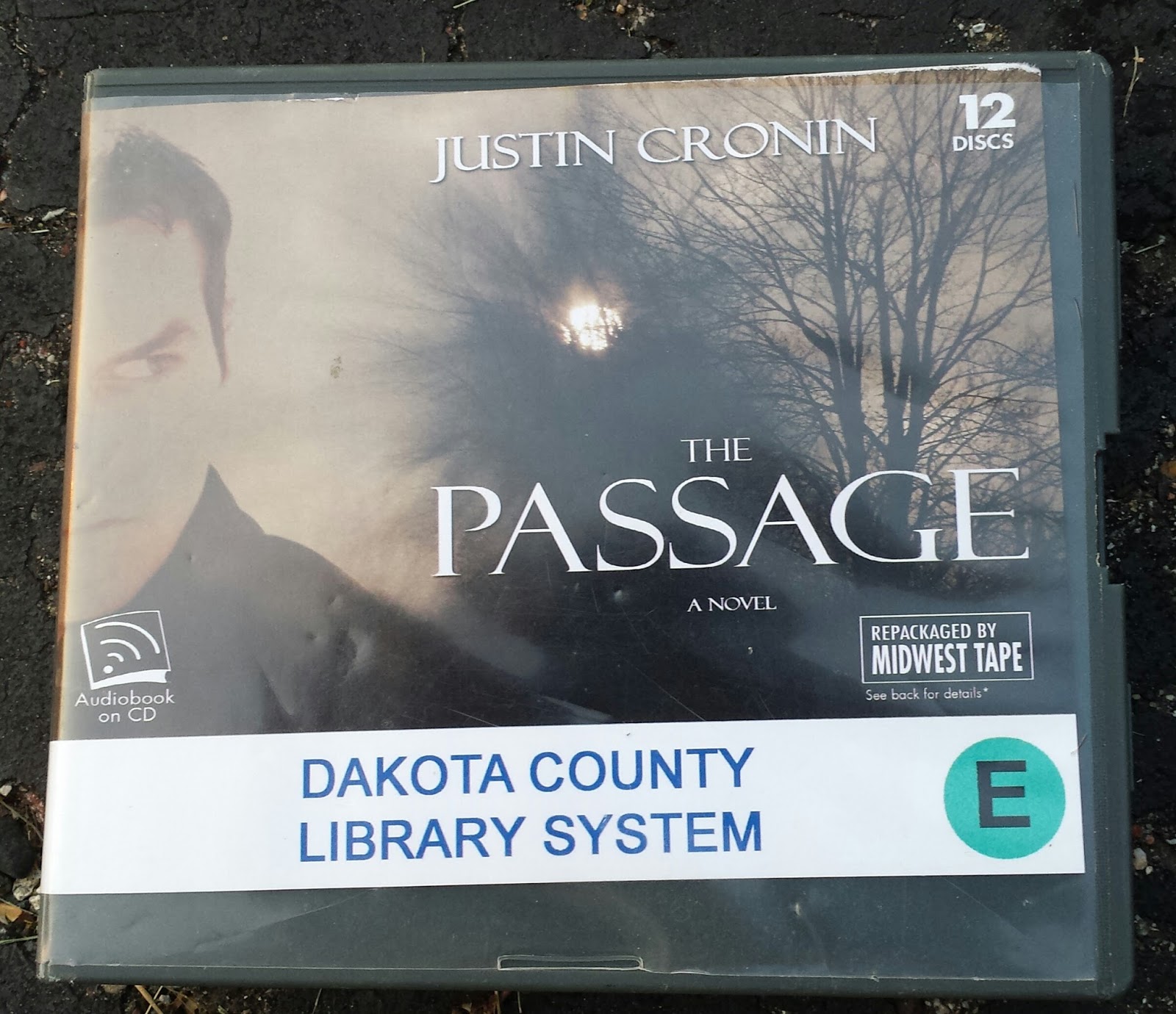
"The Passage" by Justin Cronin

Tami read this book a while back and had planned to read the sequel. We picked up this audio book to refresh her memory and get me up to speed.

Summary: In the jungles of South America, a strange virus infects an academic team. The U.S. military quickly establishes a program to research the virus and weaponize it. The virus brings on a dramatic transformation in the victim that turns them into fast, nocturnal blood-suckers. Twelve death-row inmates were the first guinea pigs and did not show the desired effects. One more subject was given the virus, but before the results could be analyzed, the facility fell and the subjects escaped. Quickly the whole continent was infected and the life as we know it is gone.

Years later the survivors struggle to make a living in a world filled with the infected creatures, called virals. Bright lights protect the isolated colony of survivors, and everyone has a job to do. But there are signs that the colony cannot last. Slowly, a plan comes together and an adventure begins.

What I Liked: There's a lot to think about in this book. The virals are fascinating, the characters are well rounded and the plot is compelling.

Tami enjoyed the layout of the plot.  The first half of the book is back-story to the action that takes place 100 years in the future.  The back-story written in such a compelling manner that it might just be my favorite part.  There is something morbidly fascinating about watching society as its known fall.

What I Didn't Like: I realized too late that this is the abridged version. I then wondered what scenes I missed. Also, my favorite character died really early.

Tami thought it was scary, and there were parts that turned my stomach.  But each bit of the plot was necessary to advance the story, so I suffered through it.

Rating: This has all the right elements of a post apocalyptic story. I recommend it.

Also Read by this Author: None.

Reviewed by: Nick (with Tami chiming in)